
Not only does Ondara have the same initials as one of the greatest musicians of all time, his silky vocals are working wonders on my eardrums. Recommended.
Not only does Ondara have the same initials as one of the greatest musicians of all time, his silky vocals are working wonders on my eardrums. Recommended.
He might, perhaps, have studied more assiduously; but it may be doubted, whether such a mind as his was not more enriched by roaming at large in the fields of literature, than if it had been confined to any single spot. The analogy between body and mind is very general, and the parallel will hold as to their food, as well as any other particular. The flesh of animals who feed excursively, is allowed to have a higher flavour than that of those who are cooped up. May there not be the same difference between men who read as their taste prompts, and men who are confined in cells and colleges to stated tasks?
~James Boswell, The Life of Samuel Johnson
What Boswell describes here of Johnson’s reading habits reminds me of Alan Jacobs’s praise of reading at Whim. (Lotta “ofs” in that sentence…)
Here are short reviews of two books I read recently about Christian business.
Business for the Glory of God, Wayne Grudem
To his credit, Grudem argues that business, possessions, money, profit, competition, and all the rest are not evil or even morally neutral, but fundamentally good. As in, blessed by God. (Exempli gratia: the commandment against stealing implies private ownership; the Proverbs 31 woman is commended for earning profit.) Grudem admits that all created goods can be used for evil, but he goes to bat for them, which is commendable.
I part ways with him in two places. First, he says that the free market produces love of one’s neighbor because you have to get along in order to do business. I don’t think so. Quashing your hatred of the local mechanic so that he’ll fix your car is not a good thing. Your hatred needs to be dealt with. I do think that business and trade are good things that will flourish in a place full of confessing Christians. I just don’t think the causation works the other direction.
Second, Grudem has far too much faith in the free market to solve the world’s ills. He tells a story of firing a painter who botched the job of painting the Grudems’ living room. Don’t worry, he says, I did that man a favor. Eventually, market forces will tell him that he’s a terrible painter and he’ll find something else to do, something he’s good at. Listen to the market and the market will reward you. It will bear you up, lest you dash your foot against a stone.
Now, a businessman should not feel guilty for firing a bad employee. In some situations, it is a favor to everyone. But the way Grudem explains it here makes it sound like the best thing you can do for someone who’s struggling financially is tell them they need to work harder. That’s not always true. The market is not kind to everyone. People do get caught in the riptides and go under.
Works of mercy require more than telling someone what they’ve done isn’t good enough. Sometimes you have to step in and show them how to do better next time. And, sometimes, you just pay the man and repaint the living room yourself.
Acres of Diamonds, Russell H. Conwell
I read these books because I do not have a head for business. This one was useful in encouraging me to look for talents hidden in my own backyard, so to speak. He’s so positive about the fact that anyone (everyone!) can make themselves rich that you almost believe him.
On the negative side, I discovered an upstream tributary of Wayne Grudem’s book. Conwell (a Baptist minister) has this bizarre blind faith in the free market. Don’t leave an inheritance to your children, he says. They won’t experience the benefit of amassing wealth for themselves. Don’t give money to the poor. It will just make them lazier than they already are. Yeesh.
One last thing: he notes that ninety-eight out of one hundred rich men are honest. Being honest is what made them rich. I think he’s probably right about that. But that doesn’t mean that honesty and riches always go together. God’s world isn’t that cut and dry.
As I’ve gotten older, I’ve (slowly) gotten better at working with the grain of who I am. For example, I don’t like staying up late to work, and I’ve learned not to feel guilty about going to bed at a decent hour. Another thing I’ve noticed about myself is that Thursdays are consistently my least productive days. I’ve always hated Thursdays because I feel like I’m never working hard enough, and the worse I feel, the worse I work. All that to say, this Thursday, I’ve been puttering around and doing a bunch of little things, and my day’s been going super well. Work with the grain, folks.
The only really effective apologia for Christianity comes down to two arguments, namely, the saints the Church has produced and the art which has grown in her womb.
~Joseph Ratzinger/Pope Benedict XVI
W. H Auden’s biographer, Edward Mendelson, wrote,
In romantic thought, repetition is the enemy of freedom, the greatest force of repression both in the mind and in the state. Outside romanticism, repetition has a very different import: it is the sustaining and renewing power of nature, the basis for all art and understanding…. Repetition lost its moral value only with the spread of the industrial machine and the swelling of the romantic chorus of praise for personal originality. Until two hundred years ago virtually no one associated repetition with boredom or constraint. Ennui is ancient; its link to repetition is not. The damned in Dante’s Hell never complain that their suffering is repetitive, only that it is eternal, which is not the same thing.
According to Mendelson, we moderns are hopeless romantics, allergic to repetition. How would marketing departments across the country feel to learn that their promises to constantly innovate are nothing more than romantic puffs?
Combined with this overweening optimism is the worship of the new. Our culture is addicted to novelty. In the days of Shakespeare, “innovation” meant the same thing as “confusion.” Those who constantly upended the past were dangerous, out of their minds. Now, of course, we are so hyper-aware that others may have something or know something that we don’t, we race to adopt new fashions, electronics, attitudes. We have convinced ourselves that keeping up with the New is our civic duty. And if we meet someone who doesn’t read the newspaper, doesn’t have Facebook or Twitter, and doesn’t have an iPhone, we treat them as some kind of fanatic. They must be tripping on something to want to avoid the New.
Our apartment is a mile from our church. During the four-minute drive from one to the other, we pass a crooked building with a loan office and a mani-pedi place on the ground floor and a cafe up top. The Mudtown Cafe, home of the worst parking lot in Birmingham.
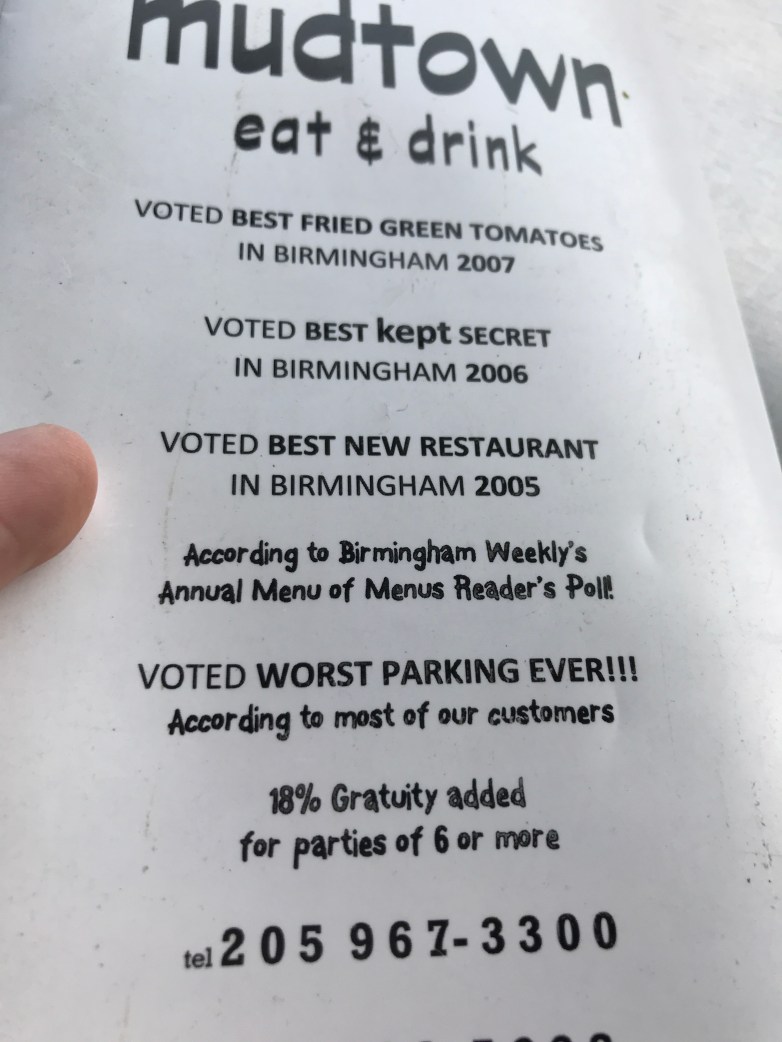
I went there for lunch today with my brother Smith. We sat out on the covered deck, where we had a good view of the Walgreens. He ordered a cajun burger and I ordered a catfish po’ boy. Both of us got cheesy grits on the side. The food was tasty. Not fantastic, not bad. The conversation scintillated. The view was dramatic, in the way all Walgreenses are. To quote Albert from the Frances books, “I like a good lunch.”
John Durham Peters writes on media and theology:
Any theology of revelation is necessarily also a theory of media. Theophany is a media problem. God needs to assume a sensory shape or work sensible effects to reach humans the classic theological issue of the Word made flesh. Any revelation is, in a way, a short-term incarnation. A burning bush, clouds of smoke and pillar of fire, thunder, voice, writing, and a highly selective glimpse of God as he departs are some of the various modes of theophany surrounding the revelation on Sinai. The mountain itself is a kind of medium, which is declared holy ground and off-limits to the footsteps of the children
of Israel.
I don’t have time to develop this at the moment, but I think we ought to consider the church as a kind of medium, communicating Christ to the world.
I believe television is going to be the test of the modern world, and that in this new opportunity to see beyond the range of our vision we shall discover either a new and unbearable disturbance of the general peace or a saving radiance in the sky. We shall stand or fall by television—of that I am quite sure.
~E. B. White, 1938
This instrument can teach, it can illuminate; yes, and it can even inspire. But it can do so only to the extent that humans are determined to use it to those ends. Otherwise it is merely lights and wires in a box.
~Edward R. Murrow, 1958
What the American people don’t know can kill them.
~Dorothy Greene Friendly, 1958
While it is true that this medium has always been in a constant state of transformation, the changes currently in process are among the most significant in its history. The very term may become less and less useful as a description, a name, for a set of interrelated communication phenomena now replacing what we have known as “television.” […] Short of massive disaster, there is no way to look at this medium and say “this is what it was; this is what it is.” “Television” has been and is always becoming.
~Horace Newcomb, 1996

 Christian Leithart