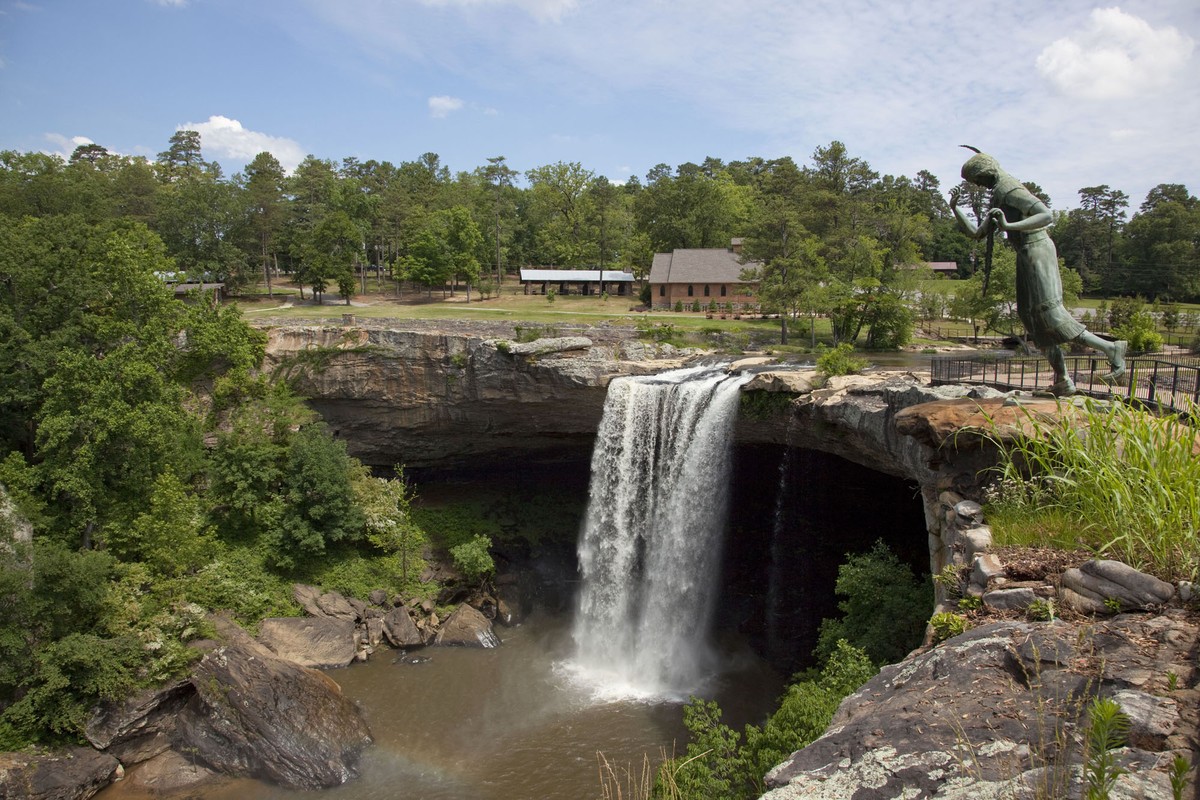
This picture of Noccalula Falls is one of fifty images of Alabama posted yesterday at the Atlantic. I live in a beautiful state, full of legends and rituals (most of the latter involving Nascar).
This picture of Noccalula Falls is one of fifty images of Alabama posted yesterday at the Atlantic. I live in a beautiful state, full of legends and rituals (most of the latter involving Nascar).
The first issue of my newsletter went out this morning, including a short essay I called “Writing in War-Time.” You can read it below, and, if you so desire, you can subscribe to the real deal here.
In 1939, almost two months after England declared war on Germany, C. S. Lewis gave a lecture about the importance of studying the humanities during a World War. Why waste time with such “placid occupations” as philosophy and literature, he asked, when men are dying in battle and the threat of invasion hangs over the nation?
We’re not in the middle of a World War, thankfully. But many of the same conditions that Lewis was concerned with exist today. A lot of people around the world are in very real danger, if not from the mysterious plague known as COVID-19, then from riots and civil unrest. It’s hard to read the headlines without dread. In such an environment, we may ask the same question Lewis poses: why spend time doing anything but the most essential activities?
Of course, what activities qualify as “essential” changes depending on who you ask (shopping? protest? worship?), but the question remains the same. In extreme circumstances, how do we justify wasting time on non-essentials? In Lewis’s lecture, “non-essentials” include studying the humanities. For me, they include writing children’s fiction and mulling over poetry while staring at the wall.
In his typical fashion, Lewis reframes the whole conversation. It’s wrong to ask whether studying (or writing) is the right thing to do in the middle of a war, he says, because the question assumes that war presents an unusual danger that must be met with an unusual response. The reality is that we are always in danger of our lives. None of us can be sure that he will be alive tomorrow. A better question, then, is whether studying or writing is ever the right thing to do. Why spend time reading Aristotle when you could be protesting? Why spend time writing poems when you could be saving souls? Why not do things that matter?
Lewis answers the question from many angles, but part of his answer is this: we waste time on “non-essentials” because we can’t help it. It’s human nature to play cards on the eve of battle. When city workers tore down a Confederate memorial in Birmingham in the middle of the night last week, they stopped for a pizza break. Even SWAT teams crack jokes on duty.
In the direst circumstances, people stubbornly remain people. They keep on humming, snickering, debating, reading, reciting, and contemplating. This means that they need good songs to hum, good jokes to laugh at, good ideas to debate, good books to read, good poetry to recite, and good art to contemplate. As Lewis says, “You are not, in fact, going to read nothing, either in the Church or in the [battle] line: if you don’t read good books, you will read bad ones. If you don’t go on thinking rationally, you will think irrationally. if you reject aesthetic satisfactions, you will fall into sensual satisfactions.”
Writing in the midst of pandemics and protests is, from the vantage point of eternity, not that different from writing at any other time. The only difference is that it’s much easier to get distracted. But the importance of the work remains unchanged. The world will have stories, and those of us who are blessed with the opportunity to write them must give the world good ones.
The world is calling us to action. But what should the artist do? Should artists set aside our pens and paintbrushes and pick up swords? The answer is far simpler and far more difficult. In times like these, the artist ought to stick to his work. Are you a chef? Make delicious food. Are you a musician? Play beautiful music. Are you a filmmaker? Capture moments in time. This present moment needs good works of art no more or less than any other, which means that it needs them vitally.
Human beings have overwhelmingly powerful cravings for novelty and unanimity. We want new problems to face, because we’re tired of the old ones: they bore us, and remind us of our failures to solve them. And, especially in times of stress, we crave environments in which dissent is silenced and even mere difference is erased. We call that “solidarity,” but it‘s more like an instinctual bullying. You must attend to the thing I am attending to. I despise both of those tendencies. They’ve turned everyone into attention muggers.
Alan Jacobs

For manifold reasons, I’ve decided to start a newsletter. I’m calling it Time’s Corner, after a phrase the Green Lady says to Ransom in Perelandra.
Do not wonder, O Piebald Man, that your world should have been chosen for time’s corner. You live looking out always on heaven itself, and as if this were not enough Maledil takes you all thither in the end. You are favoured beyond all worlds.
[Quote cribbed from here]
What the Green Lady is refering to is the time and place at which all of reality bends: the death of Christ on a cross in Jerusalem. I don’t pretend that this newsletter will be anywhere near as significant as that Event of Events, of course. But I do want the things I write about here to direct the attention of whoever reads them to that most crucial point. After Jesus died, rose, and ascended, nothing was the same, and that includes writing, art, and email newsletters. We’re still figuring out its ramifications. Consider this another teeny push in that direction.
Here’s the plan. On Mondays, I’ll send out a mid-length essay about writing, literature, or art. At the end of the Monday issue, I’ll ask my readers a question, like, “What’s a non-biblical quote or poem that never fails to encourage you?” On Thursdays, I’ll send out my favorite responses to the question, along with some comments.
If that sounds like a jolly old time to you, sign up here.
I grew up in a church that took the psalms seriously. We used a combined hymnal and psalter and each Sunday sang liberally from both halves. It was a great concern of the church leadership that the congregation become familiar with the entire book of Psalms, but it was slow going. Teaching anything to a church takes a while. Teaching them to sing is a years-long process.
As Alastair Roberts says in the video below, Christians need a fuller and less abbreviated relationship with the psalms, since the psalms, sung in their entirety, teach us how to navigate the peaks and valleys of life.
It’s a grand idea, but how does it work in practice? How does a music minister go about teaching the entirety of Psalm 68 to a congregation? A repetitive, metrical version would be easy to learn, but wouldn’t communicate the various sections of the psalm. A through-composed version, which includes the whole psalm in a more or less literal translation, is tougher to learn and almost impossible for a large congregation to sing well. How about good old chanting? Rare indeed is the 21st-century parishioner who doesn’t need a significant amount of coaching to handle a chant.
The question is how to translate Alastair’s (very good) theological point into an actionable plan for pastors and musicians. Answering that question – or, at least, approaching an answer – is one of the reasons I decided to start a yearly music colloquium called Psalm Tap. (Big props to Jarrod Richey for getting this off the ground.) Psalm Tap is where pastors, musicians, and interested laypeople will discuss the nuts and bolts of teaching and composing church music, with a particular focus on the psalms.
Psalm-singing will be a big focus at the colloquium, but other topics are on the table, such as whether we should use books or bulletins for music, what kinds of instruments are appropriate in worship, and how a church can pay for their high aesthetic vision. I anticipate strong opinions and good fun.
The colloquium is free. If you’re in Louisiana in late June, please join us.
UPDATE: Thanks to some health issues, I won’t be attending the colloquium this year. But don’t let that stop you from going. ‘Twill be a grand old time regardless.


Anything’s possible. Or if
Sally Thomas, “New Year’s Day”
Impossible, still possibly worth doing.
Some of the folks on the CREC music email list are discussing the pros and cons of physical psalters and hymnbooks. I decided to weigh in…
Growing up in Moscow, I got used to singing out of the Cantus Christi. My copy (of the venerable blue variety) got so worn over the years that its spine is currently being held together by duct tape. I understand the practical advantages of singing from a bulletin or even a projector screen during worship, but my experience demonstrates some of the advantages of using a hymnal over time, both in worship and in casual settings.
For one thing, there’s the fact that over time the physical hymnal became a familiar object. Even when I didn’t remember page numbers, I remembered generally where in the book a particular hymn or psalm was because I knew what the two halves of the book felt like in my hands when I was singing that one. (Now that I think of it, hymns near the middle of the book may have been more popular simply because the book was easier to hold when it was open to that position.) I even remember the location of certain hymns because of the communion wine stains on the edge of the page.
Another benefit of having a common physical hymnal was that any gathering of church members could grab a few copies and have an impromptu psalm/hymn sing. Having sung all the same stuff for years, we knew what we knew and what we liked. It was a treat when we had a group skilled enough to sing one of the fugue tunes (e.g., ‘Tis By Thy Strength), and when we didn’t, we knew that there were simpler crowd-pleasers available. Whether hanging out in the park or in a friend’s living room, we always had the option of singing together. One hymn would remind someone of another favorite and we could all flip to that page and give it the old college try. It was even better if half the group knew the hymn and the other half didn’t, since that gave you the chance to learn a new tune. I always hoped that eventually I’d know every song in the Cantus. The physical book gave me something to shoot for.
Lastly (for now), a physical book gives you the magical ability to browse. Digital editions are great for finding something when you know what you’re looking for, but if you’re hanging out at the piano on a Sunday afternoon, plinking away, you definitely want a physical hymnal to flip through.

