

I don’t know much about Ansel Adams. I’d only recognize a few of his pictures without help. But since he was one of the best black-and-white photographers of the 20th century, I need to know something about him. Last July, I got the book Examples: The Making of Forty Photographs to learn.
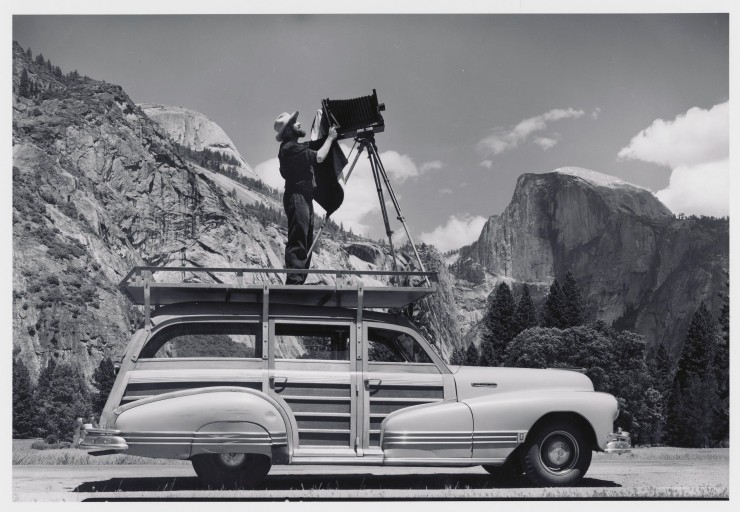
The first thing that struck me was that Adams never uses the phrase “take a picture.” He always, without fail, says, “make a picture.” For him, pictures do not exist, waiting to be snatched. They must be made. He describes all the ways he framed, exposed, and washed his photos to get the desired effect.
Speaking of the desired effect, Adams writes a lot about the importance of visualizing your image ahead of time. It’s not enough, apparently, to just snap a photo and decide what you think about it later. You must pre-conceive the image so that you know what you’re going for. This is what Adams calls the “internal event,” which he explains in this short clip.
The whole key lies very specifically in seeing it in the mind’s eye, which we call visualization. The picture has to be there clearly and decisively, and if you have enough craft and, you know, working and practicing, you can then make the photograph you desire.
I think this same technique can be applied to arts other than photography. Often, when I begin a poem or an essay or a story, I meander around on the page, trying to get my thoughts in order. I would say this is the equivalent of taking a walk, looking for subjects to make photographs of. Eventually, my imagination catches on something and I have an impression (not quite a visualization) of what the final written product could be like.
I’m sure everyone has experienced some version of this. How often have you been talking with your friends when one of you says something and you think, “That would make a good movie?” In a way, you have preconceived the whole story in your head, based purely on one offhand comment. Of course, the final product is rarely like what exists in your imagination, but that’s where the craft comes in. All the artist’s work and practice is for making the most of those moments of visualization.
As an unabashed disciple of Ray Bradbury and Steven Spielberg, both masters of balancing the timeless and the tasteless, I approve of this message. Partly, I approve because this is the just kind of thing I need to hear, as I am way, way too perfectionistic about my writing.
I’m reminded of something Austin Kleon wrote about his son in Keep Going. When it came to drawing, not only was his son “medium agnostic,” he also didn’t seem to care about the finished product. All of his energy was focused on the verb.

I’ve noticed this same thing about my daughter. If I hand her five sheets of blank paper, she’ll draw five spirals in five different colors and then ask for more sheets.
Back to the article on pulp fiction, the author gives three lessons we can learn from the pulpists.
Artists of all kinds are suspicious of money. (With good reason, in some cases.) Money can inject a healthy amount of work ethic into your writing, however. The list of great books that were written because someone was desperate for a paycheck is endless. The need to sell a story can make you more realistic about what to leave and what to cut, when you need to finish, and who you should be writing for.
This piece of advice goes hand-in-hand with the one above. If you need to get paid, you need to get an audience. And if you need an audience, you need to hook them and reel them without wasting any time. You do that by appealing to their guts. During an interview one time, Darren Doane gave someone the following scenario.
You’re in front of a whiteboard. A guy hands you a marker and says, “In sixty seconds, your family is going to walk through that door. You need to write something on the board that will cause them to have a physical reaction – laughing, crying, whatever. If they don’t react, I’ll shoot all of you.”
The guy who was interviewing Darren said that he’d probably write something dirty, since that would be the easiest way to get a physical reaction. Darren said, “And you’ve just explained ninety percent of movies.”
A little violent for a thought experiment, perhaps, but his point is that this is the situation every artist (writer, musician, filmmaker) finds himself in. The stakes are high, and you have a limited amount of time. Don’t ask your readers to care. Make them care. Hook their guts.
This is actually a big theme of Austin Kleon’s books, which I get mixed up because I read them back to back. You might think that in order to produce good work, you need to save up for it, but in fact the opposite is true. Good work only comes once you’ve gotten rid of the bad and the mediocre stuff. Produce vast amounts. Discard a little less than you produce. Find the diamonds.
The upshot of all of this is a word of advice to myself: don’t let the pulp writers outdo you. You can write worse stuff faster than they can.



And you can, too.
I’ve mentioned Josh Gibbs here once or twice. His was one of the first blogs I regularly read. Today I learned that, lo! he blogs again.
He explains why in this post over on his Circe column.

Why, you ask, have you been posting pictures instead of that sweet, sweet written content I patronize this site for? Aren’t you a writer? Hey, man, I reply, I have been writing, just not for this venue. Chill.
The real reason is that I’ve been too busy teaching to think about the things I usually blog about. Since my place of employment has, like every high school in the country, gone virtual, I’ve been using Youtube to teach Latin.
You can watch more Latin vids here, if you wish. Meanwhile, all I can say is, “Utinam iterum in schola doceam!”
 Christian Leithart