The world seems to be filled with people who have certain gifts and certain interests but are continually forced to acknowledge that the institutions that have been created to foster those gifts and serve those interests have ceased to do so…. If the institutions won’t do it for us, we’ll have to learn how to do it ourselves. And then maybe these amateurish and improvised endeavors will eventually develop into new institutions.
Alan Jacobs
Tag Archives: Good Work
Make Your Own Contemporaries

Support the Finishing
Sometime I think that, even amidst all these ruptures and renovations, the biggest divide in media exists simply between those who finish things, and those who don’t. The divide exists also, therefore, between the platforms and institutions that support the finishing of things, and those that don’t.
Finishing only means: the work remains after you relent, as you must, somehow, eventually. When you step off the treadmill. When you rest.
Finishing only means: the work is whole, comprehensible, enjoyable. Its invitation is persistent; permanent. […] Posterity is not guaranteed; it’s not even likely; but with a book, an album, a video game: at least you are TRYING.
Robin Sloan
I didn’t know it at the time, but this was surely the impetus behind Good Work, a reaction against the endless “now” of social media. A print magazine must be finished before it be mailed to subscribers. When it’s finished, it’s done. It exits. The work has ended for now. You can rest.
In the new year, I plan to start a crowdfunding campaign for a limited run of Good Work. I think that’s the way forward: plan the issues, raise money, write, print, send. I’m sure I’ll cite Robin’s newsletter here in support of the project.
Culture War is Necessary
The first issue of Good Work contains an article explaining the mission of the magazine. Man, that was tough to write. I wanted to reframe the terms of the “culture war” without a) throwing down my weapons or b) picking unnecessary fights. I’m not 100% sure I succeeded. Judge for yourself.
Or you could read this excerpt from Doug Wilson’s recent newsletter on education (paywalled, unfortunately). Leave it to Doug to say what I’m thinking more lucidly than I can.
Chesterton spoke wisely of the man who fights, not because he hates what is in front of him, but because he loves what is behind him. And I have taught (for decades I have taught) that just as you cannot have a naval war without ships, or tank warfare without tanks, so also you cannot have culture war without a culture. And a culture is something you must inhabit, as one who loves his home, and so you must inhabit it as a dutiful citizen who is devoted to . . . culture care.
This means an essential part of culture care is fighting off invasions, and resisting predation. When the Germans conquered France, and were confiscating enormous stores of rich wines, culture care needed to include hiding wine from the Nazis, as in fact it did. But in order to do this, there would have to be some recognition of why they were needing to hide wine from the Nazis. Not to be too obvious about it, they were having to do this because of an invasion. There was a war on because someone was attacking. There was a culture war because someone was invading and seizing the cultural artifact—wine.
As he says, “you cannot have a culture war without a culture.” This means someone has to be plowing, sowing, watering, and harvesting to feed the man on the front lines. Good Work is that first guy.
The flaw in my analogy is that, in a real war, the farmer and the warrior are mutually exclusive. As long as the farmer’s planting, he’s not fighting. When he takes up his pitchfork to fight the bad guys, he has to ignore his fields for a bit. For Christians, good work, done to the glory of God, is an act of war. The man who cares for his family, goes to church, reads the Bible, sings the Psalms, and prays for his country is a culture warrior even if he never holds a picket sign. In other words, a faithful Christian life is always warlike, though it may not look like it from the outside.
You may have seen the video of Doug torching a bunch of cardboard cutouts with a flamethrower. Lots of people loved it. Lots of people hated it. But most of them ignored the most important part, which came near the beginning:

Here we footage from the front lines of the culture war. Want to do your part to demolish the city of man? Eat dinner with your family.
That said, there are times when Christians must behave like warriors in the conventional sense, when we must be belligerent and accept nothing less than victory. What if Martin Luther had been content to read Romans in the privacy of his own home (for the sake of not causing a fuss) and never challenged the authority of the pope? For that matter, what if the apostles had kept the news of the resurrection to themselves, so as not to ruffle any feathers? Sometimes, being a faithful Christian means picking a fight.
How do you know when to tend to the farm and when to grab your flintlock? Good question. We’re certainly living in times that require us to work through the answer.

New Good Work Coming Soon
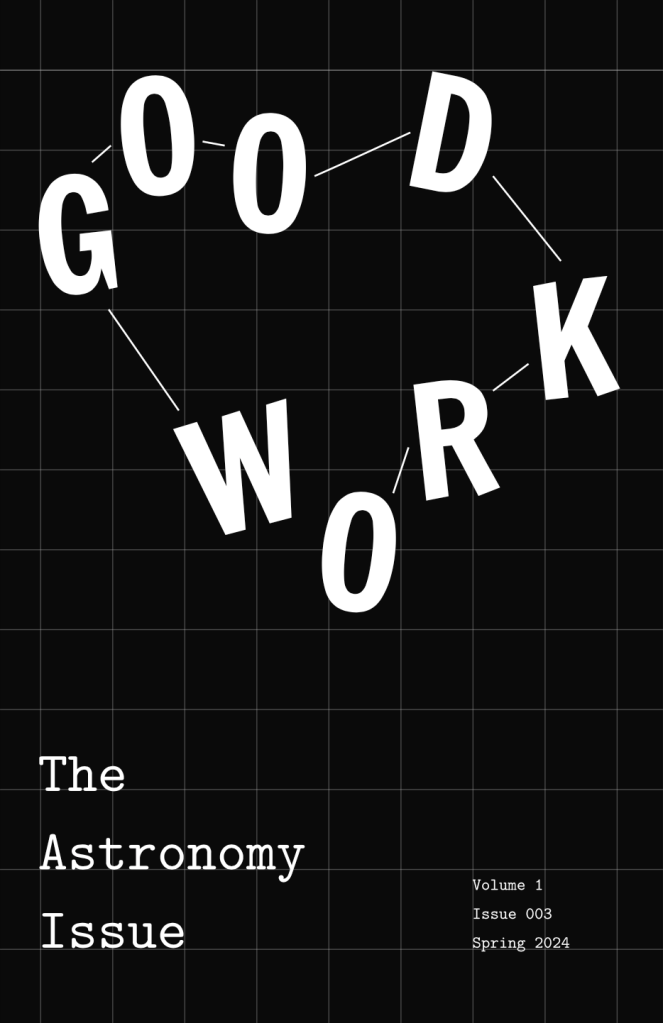
Finally.
It’s been a bumpy twelve months for Good Work, the print zine I started last year. After two smashing successes, we got off track and haven’t mailed an issue since… Last summer, I think? Above, you can see the cover of our latest issue, which I sent to the printer just the other day. Issue #4 is nearly ready for the graphic designer (Theme: Mend and Make Do). I reckon we’ll be able to assemble one more issue in 2024 (Theme: Leisure).
After that, who knows? It’s funny how cheap the digital world is compared to the real one. My digital newsletter, Time’s Corner, costs me nothing but… well, time. Producing a single issue of Good Work involves many hours of work for multiple people, printing and postage, not to mention the costs of renting a PO box and keeping the website alive. I’d like to say the finished product is worth it, but it’s tricky to measure success when your readers are silent and distant. The best thing about Good Work (being print-only) is also its most challenging thing. I’ve been spoiled by the instant feedback that comes with online publishing.
Please subscribe to share the goodness.
The Makers by Dorothy Sayers
The Architect stood forth and said:
“I am the master of the art:
I have a thought within my head,
I have a dream within my heart.
“Come now, good craftsman, ply your trade
With tool and stone obediently;
Behold the plan that I have made—
I am the master; serve you me.”
The Craftsman answered: “Sir, I will
Yet look to it that this your draft
Be of a sort to serve my skill—
You are not master of the craft.
“It is by me the towers grow tall,
I lay the course, I shape and hew;
You make a little inky scrawl,
And that is all that you can do.
“Account me, then, the master man,
Laying my rigid rule upon
The plan, and that which serves the plan—
The uncomplaining, helpless stone.”
The Stone made answer: “Masters mine,
Know this: that I can bless or damn
The thing that both of you design
By being but the thing I am;
“For I am granite and not gold,
For I am marble and not clay,
You may not hammer me nor mould—
I am the master of the way.
“Yet once that mastery bestowed
Then I will suffer patiently
The cleaving steel, the crushing load,
That make a calvary of me;
“And you may carve me with your hand
To arch and buttress, roof and wall,
Until the dream rise up and stand—
Serve but the stone, the stone serves all.
“Let each do well what each knows best,
Nothing refuse and nothing shirk,
Since none is master of the rest,
But all are servants of the work—
“The work no master may subject
Save He to whom the whole is known,
Being Himself the Architect,
The Craftsman and the Corner-stone.
“Then, when the greatest and the least
Have finished all their labouring
And sit together at the feast,
You shall behold a wonder thing:
“The Maker of the men that make
Will stoop between the cherubim,
The towel and the basin take,
And serve the servants who serve Him.”
The Architect and Craftsman both
Agreed, the Stone had spoken well;
Bound them to service by an oath
And each to his own labour fell.
(Discovered in Sayers’ The Man Born to be King)
Using a Scythe
So great an art can only be learnt by continual practice; but this much is worth writing down, that, as in all good work, to know the thing with which you work is the core of the affair. Good verse is best written on good paper with an easy pen, not with a lump of coal on a whitewashed wall. The pen thinks for you; and so does the scythe mow for you if you treat it honourably and in a manner that makes it recognise its service.
Hilaire Belloc, Hills and the Sea
Before All Things Else
What distinguishes [the artist] here from the man who works to live is, I think, his desire to see the fulfilment of the work. Whether it is possible for a machine-worker to feel creatively about his routine job I do not know; but I suspect that it is, provided and so long as the worker eagerly desires that before all things else the work shall be done. What else causes the armaments worker to labour passionately when he knows that the existence of his country is threatened, but that his heart travels along the endless band with the machine parts and that his imagination beholds the fulfilment of the work in terms, not of money, but of the blazing gun itself, charged with his love and fear. As the author of Ecclesiasticus says, he “watches to finish the work”; for once, that is, he sees the end-product of his toil exactly as the artist always sees it, in a vision of Idea, Energy, and Power. It is unfortunate that so little effort should be made by Church or State to show him the works of peace in the same terms. Is the man, for example, engaged in the mass-production of lavatory cisterns encouraged to bring to his daily monotonous toil the vision splendid of an increasingly hygienic world? I doubt it; yet there is much merit in sanitary plumbing—more, if you come to think of it, than there is in warfare.
Dorothy Sayers, The Mind of the Maker
Work by the Standard of Eternity
That the eyes of all workers should behold the integrity of the work is the sole means to make that work good in itself and so good for mankind. This is only another way of saying that the work must be measured by the standard of eternity; or that it must be done for God first and foremost; or that the Energy must faithfully manifest forth the Idea; or, theologically, that the Son does the will of the Father.
Dorothy Sayers, The Mind of the Maker
 Christian Leithart