A Man Makes No Emotional Sense

Francis Spufford is a talented novelist. He has won prizes for his non-fiction. So I was interested to read his “non-defense” of Christianity, Unapologetic: Why, Despite Everything, Christianity Can Still Make Surprising Emotional Sense. Apart from a few paragraphs here and there and one chapter (“Yeshua,” for those with the table of contents in front of them), it was, in the words of Christopher Hitchens, “not great.”

The problem, as I see it, is that Spufford is trying to have it both ways. He both does and does not want to defend his Christianity to other smart Brits. He does, because he doesn’t like being mocked by them (understandably so). He doesn’t, because he doesn’t really like formal apologiae, defenses of Christian belief. They are, he would say, not true to the actual experience of being a Christian. The question he wants to answer is “what does it feel like to be a Christian?” He’s going for “emotional sense.” Does he manage it? Sort of.

The book is laid out in a definite order, if not quite an argument. Spufford starts with what he calls the “human propensity to f*** things up” (HPtFtU, for short), which he assumes we will all recognize. Given that HPtFtU, especially as it applies to one’s own personal life, it makes sense that the next emotional (not logical) step is to peer into every corner of the universe in search of help. Many people find no help at all. Some people, Spufford among them, find, somewhere at the back of things, a kind of intuitive sense of all-powerful goodness. He sits in a quiet church, closes his eyes, and lets his thoughts roam freely. His insignificance washes over him. His utter helplessness. His wish to make things right. And, Descartes-like, he realizes that his very wish for goodness is a sign that goodness must be out there, somewhere. Despite his crookedness, he remains alive, though small beyond comprehension. Something larger and better than him consciously keeps him going. Throwing himself on the mercy of that large, good thing seemed like the best course of action. As an acquaintance of mine likes to say, “Why is there something rather than nothing? Looks like it’s time to worship!”

From there, Spufford reaches the problem of pain. (If there’s some all-powerful goodness at the back of things, why do I hurt?) His answer to the problem of pain is to throw up his hands and say, “No idea. All the explanations are bollocks. Christians just move on.” Okay… Moving on is part of it, so let’s do that now. Next up, a man in ancient Israel, a man who is that all-powerful goodness and yet fragile and time-bound and utterly human. Spufford’s description of Jesus’s ministry and death is the strongest part of the book by far. Nearly all of the “emotional sense” of the book is contained in this one chapter. The resurrection passes in a blink, then there’s a sort of muddle while he goes through all of the bad things Christians have supposedly done. His treatment of tradition is pretty poor, as is his understanding of the Bible. He has very odd ideas about morality, especially sexual. But he stalwartly declares his union in the body of Christ with undesirables such as Sarah Palin, whom he personally finds horrifying, so I have to admit that, yes, Francis Spufford is a brother in Christ. Christ, check. Church, check. Grace and peace, brother.

I may have mis-remembered bits and pieces of the book in my summary since I don’t have it in front of me. That’s entirely appropriate, since Spufford did no research for his writing, either. I did admire his willingness to admit that he could be wrong about things, but he was far too willing to distance himself from uncool intellectual positions. “Not all Christians believe thus-and-such” was his favorite line.

More than anything, the book affirmed my belief that, when Christians waffle on Scripture, they waffle on everything. Spufford pegs the early chapters of Genesis as a quaint myth. The Old Testament testifies to the Hebrews’ slow understanding of monotheism. The gospels were assembled decades after Christ’s ministry. (Yeah, right. These were Jews, Francis. They wrote down everything.) I may be one of the “really stubborn Americans” he mentions several times in the book, but I’m convinced that we have to treat the Bible as God’s Word, no matter what uncomfortable situations that may put us in (including defending creatio ex nihilo). There is no defense, emotional or otherwise, of Christianity that is not grounded in Scripture.

So does the book defend Christianity’s emotional sense? It defends a shaky truce between Christianity and acceptable British intellectual culture. But who says British intellectuals have their emotions in order?

A Man is Fit to Burst

Rachel Jankovic’s second book on raising kids, Fit to Burst, had some really good sections that I, as a part-time stay-at-home dad, want to remember. And, as the wise man said, blogging something is the best way to remember it.

In Christian circles there is constant talk about free salvation. It is free, thank God. But it is only free to us. God paid a great price for it. Jesus paid with His blood. It is free to us because someone else paid a great deal. And this is why we do not work out our salvation by never doing anything that might be hard or difficult to us. We imitate Christ, and we make sacrifices for others. We do things that are hard, that cost us much, because we want our gifts to be free to others.

It can be tricky to walk the line between “by grace you have been saved” and “work out your own salvation.” Why try to do good works when salvation is given freely? Rachel gets right at the heart of it here. Salvation is given freely, but that’s only possibly because Jesus paid for it dearly. Rachel ties this to parenting by making the point that the gifts your children receive may be free to them, but they most likely came at a heavy cost to you (straining the budget, staying up late, long days at work). Like God, we joyfully pay the price so that others can receive freely.

Lord willing, your kids pay it forward.

You would like to see your kids taking what they were freely given and turning it into still more free giving. This is because God’s story is never little. He works in generations, in lifetimes, and He wants us to do the same.

I love how Rachel emphasizes the generational scope of God’s promises. Good stuff.

Another:

Good leadership is engaged and involved the whole time. It is clear about expectations and consistent about consequences. But good leadership always starts with the leader. It always starts with what you expect of yourself. If you are engaged in disciplining yourself, your children will know.

One way children learn self-discipline is by seeing their parents act it out. Someone (I forget who) used the analogy of the new recruits who think the drill sergeant is being harsh when he drags them out of bed at five in the morning. The recruits forget that the sergeant had to drag himself out of bed at 4:30 in order to give them their unwelcome wake-up call. Leaders are held to a higher standard. That’s as it should be.

One more:

In our house, we make a point to discipline only when we have a biblical name for the offense, because we want our children to know that what we are doing is enforcing God’s law. So they would know they are being disciplined for disobeying their parents, not splashing in the sink.

Just a good rule of thumb: if you can’t name the sin, don’t discipline for it. You can make a rule against splashing in the sink if you want to, but then the kids will be disciplined for breaking the rule, not for their overexuberance.

A Man Named CS Lewis Drew Comics

Did you know this? I didn’t. Tolkien was always the doodler in my mind.

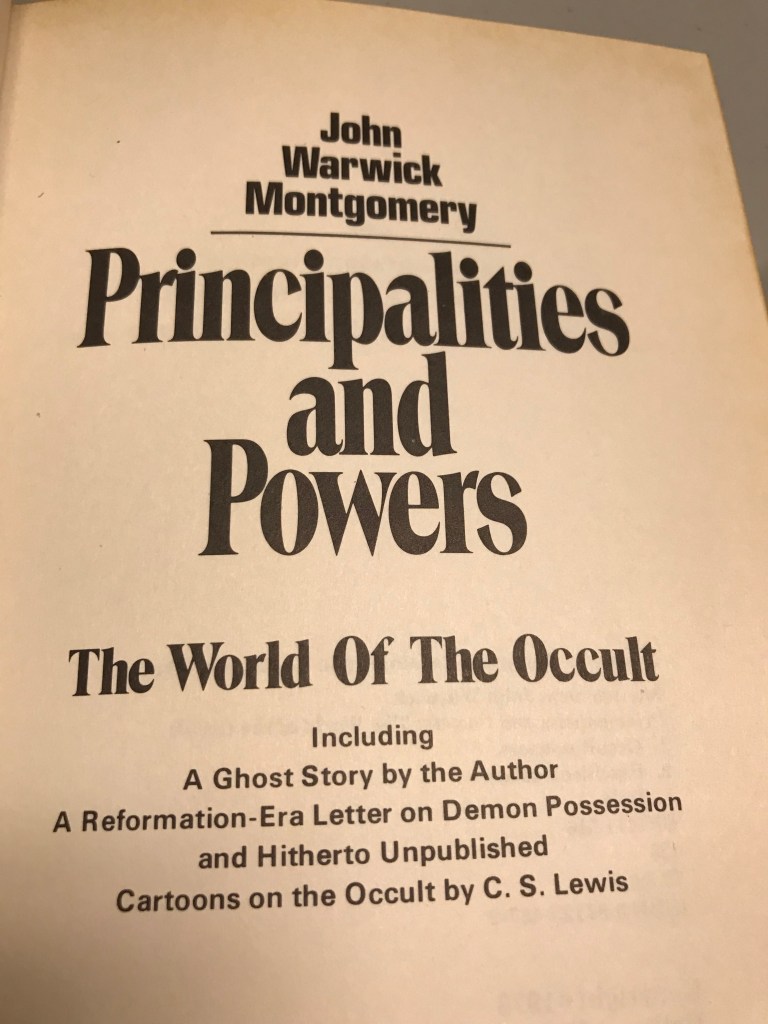
Cataloguing books at Theopolis today, I snagged my eye on the subtitle of this one.

img_4224

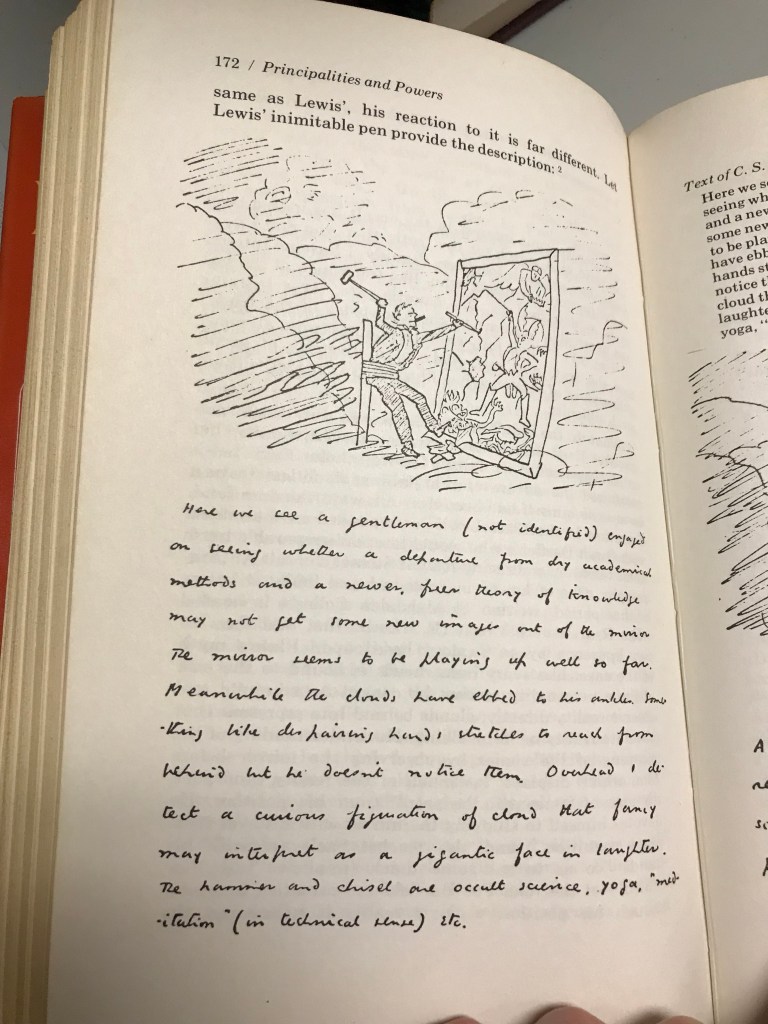
“Hitherto Unpublished Cartoons on the Occult by C. S. Lewis?”

I flipped through till I found them.

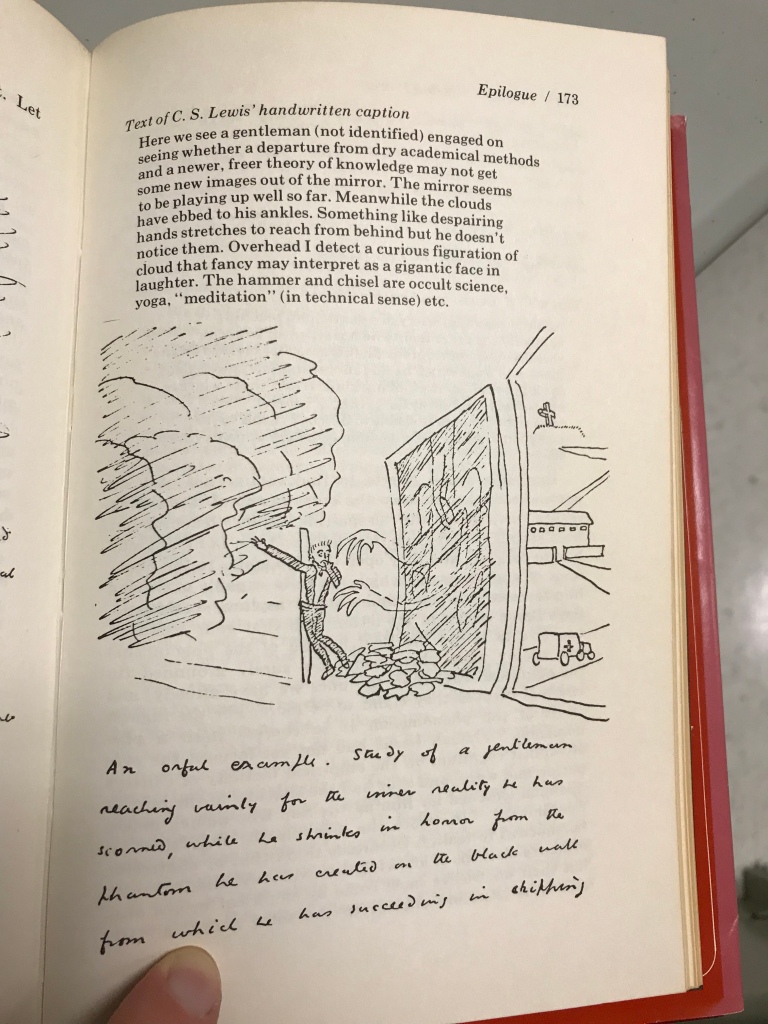
img_4225

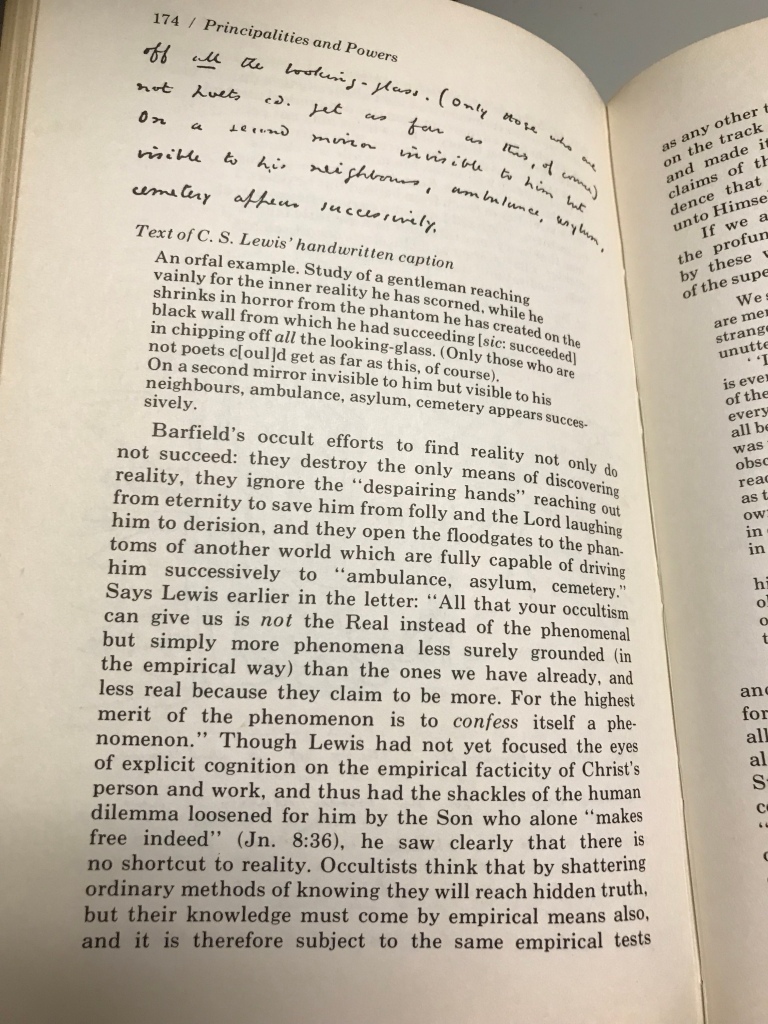
img_4226

img_4227

The context is a letter from Lewis to his friend Owen Barfield, who was toying with occultist ideas like anthroposophy (which I have known about for around ten minutes). Lewis is explaining to Barfield why his approach to reality is flawed – the letter is headed “The Real Issue between Us.” I’ll let the author summarize the rest. (It’s worth noting that Lewis wrote this before becoming a Christian.)

Lewis first describes his own approach by an analogy based upon Plato’s myth of the cave: like every man, Lewis is bound to the post of finite personality so that he cannot turn around and observe reality directly; clouds behind him represent that ultimate reality or True Being. His understanding of the meaning of life comes by observing the mirror before him, which displays “as much of the reality (and such disguise of it) as can be seen” from his position. He devotes himself to studying the mirror with his eyes (“explicit cognition”) and also reaches backward with his hands “so as to get some touch (implicit “taste” or “faith”) of the real.” For Barfield the occultist, however, though his position vis-à-vis reality is necessarily the same as Lewis’, his reaction to it is far different.

What I take away from Lewis’s little attempt at art, besides once again recognizing the man’s incredible gift for coming up with analogies, is his attitude toward his own drawing. In his description of the first sketch, he seems to barely recognize the details of what he drew, almost as though he’s discovering it for the first time: “something like despairing hands,” “I detect a curious figuration,” “fancy may interpret.” I wonder if this is something that undergirds Lewis’s imagination throughout his career as a writer, that sense of exploring his own creations as though they carried on a lively existence completely independent of their maker.