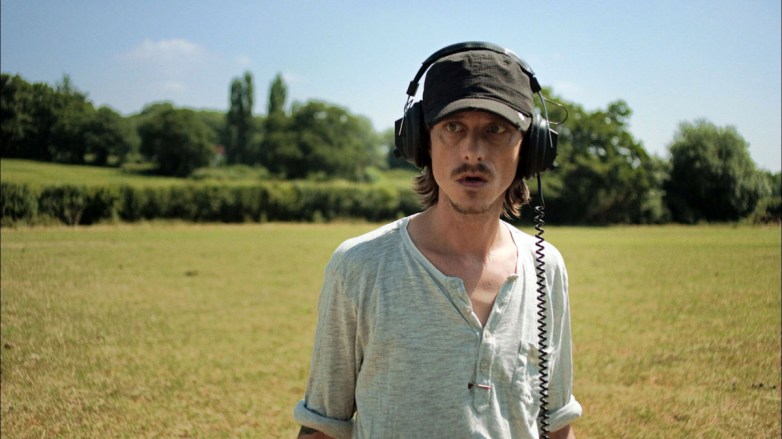
A Man Goes to Mudtown

Our apartment is a mile from our church. During the four-minute drive from one to the other, we pass a crooked building with a loan office and a mani-pedi place on the ground floor and a cafe up top. The Mudtown Cafe, home of the worst parking lot in Birmingham.

I went there for lunch today with my brother Smith. We sat out on the covered deck, where we had a good view of the Walgreens. He ordered a cajun burger and I ordered a catfish po’ boy. Both of us got cheesy grits on the side. The food was tasty. Not fantastic, not bad. The conversation scintillated. The view was dramatic, in the way all Walgreenses are. To quote Albert from the Frances books, “I like a good lunch.”

A Man Considers the Church as Medium

John Durham Peters writes on media and theology:

Any theology of revelation is necessarily also a theory of media. Theophany is a media problem. God needs to assume a sensory shape or work sensible effects to reach humans the classic theological issue of the Word made flesh. Any revelation is, in a way, a short-term incarnation. A burning bush, clouds of smoke and pillar of fire, thunder, voice, writing, and a highly selective glimpse of God as he departs are some of the various modes of theophany surrounding the revelation on Sinai. The mountain itself is a kind of medium, which is declared holy ground and off-limits to the footsteps of the children
of Israel.

I don’t have time to develop this at the moment, but I think we ought to consider the church as a kind of medium, communicating Christ to the world.

A Man Presents Some Quotes about TV

I believe television is going to be the test of the modern world, and that in this new opportunity to see beyond the range of our vision we shall discover either a new and unbearable disturbance of the general peace or a saving radiance in the sky. We shall stand or fall by television—of that I am quite sure.

~E. B. White, 1938

This instrument can teach, it can illuminate; yes, and it can even inspire. But it can do so only to the extent that humans are determined to use it to those ends. Otherwise it is merely lights and wires in a box.

~Edward R. Murrow, 1958

What the American people don’t know can kill them.

~Dorothy Greene Friendly, 1958

While it is true that this medium has always been in a constant state of transformation, the changes currently in process are among the most significant in its history. The very term may become less and less useful as a description, a name, for a set of interrelated communication phenomena now replacing what we have known as “television.” […] Short of massive disaster, there is no way to look at this medium and say “this is what it was; this is what it is.” “Television” has been and is always becoming.

~Horace Newcomb, 1996

A Man is a Mad Man

With the first season of Mad Men under my skinny, yet expensive leather belt, I thought I’d cast my crumbs of thought on the waters of the internet.

  • Initially, the pace of the show frustrated me. I could never tell when an episode was about to end. Events just bled into one another. I still could not tell any of the first eight episodes apart. Part of it has to do with watching the show on Netflix, of course. But I remember distinct episodes from 30 Rock, Community, and Better Call Saul, all of which I watched on the computer.
  • Either I locked into the show’s groove or the show locked into mine. It was at the end of Episode 9, “Shoot,” when I turned off the TV, rolled over in bed, and thought, “I liked that. That was good.” From that point till the end of Season 1, I enjoyed it.
  • The show is a little too pleased with itself in terms of style and production design. Sure, it’s impressive. Even captivating at times. It’s fun to have the characters say “swell” like the Hardy boys. But the precision of all the details cuts both ways: it presents the past in gorgeous HD, as you’ve never seen it before, while underscoring how different it was from our present day. And the show can’t stop itself from commenting on those differences. Every man in the show is a womanizer. Every women struggles against the boundaries of her sex. Every character is consciously classist and casually racist. It’s like reading Huck Finn in an English class with a teacher who can’t get off the subject of slavery.
  • On the whole, the show is about loneliness. Or, more accurately, about knowing and being known. Every character tries to build, earn, or steal for themselves a sense of worth, a place in the world and among people. Don Draper is the quintessential example. The people most willing to accept and embrace him, his family, don’t know anything about his past. They don’t even know his real name.

A Man Had a Thought About Tech-Wise Families

I started an online book group with a couple of friends, David K. and Jon B. The second book we read (just finished last week) was The Tech-Wise Family, by Andy Crouch. It was pretty good, holding the football steady so we could kick off a lively discussion. I’m not going to summarize or review it here. I just want to talk about something Crouch says in the section called “Shaping Space.”

He says that his one key recommendation, his if-you-only-remember-one-thing-from-this-book recommendation, is this: “Find the room where your family spends the most time and ruthlessly eliminate the things that ask little of you and develop little in you.” Good advice. Push yourself to become skillful in things. Pursue wisdom and gain courage. When I started to think about how I would apply this is my family, however, I immediately had questions…

My wife and I are sitting on the sofa in our living room right now, she reading, I typing this sentence. The wall opposite the sofa is mostly covered with books. To the left of the bookshelves is an electric keyboard, piled with sheet music. Above that hang two guitars. Now, this seems to pass the tech-wise assessment test. Books and musical instruments ask a lot of you and develop a lot in you, right? That may be true, but that’s not why we have them in our living room. We have the books because we enjoy reading. We have the instruments because we enjoy playing them. We hope that our daughter will enjoy both activities, too, of course, and so far, she does.

But let’s imagine that we had on the wall of our living room, not books, but a giant TV (like we do in the bedroom, ahem…). And let’s imagine that, after reading Tech-Wise, my wife and I agreed to ruthlessly eliminate the TV and replace it with a complete set of Britannica’s Great Books of the Western World. Would we grow apt to pull a volume down and flip through it? I don’t think so. Far more needs to change than the furniture.

I still think Crouch’s advice is good. (And you should still read the book.) The architecture and layout of your home will affect how you spend your time there. But I think we need to spend more time thinking about the role enjoyment plays in all of this. I can all too easily imagine a father and mother who, determined to ask more of their family, make their home a place where nobody wants to be (including the two of them). If you are really trying to wean yourself off your TV or smartphone or Netflix subscription, start with something small and enjoyable. Instead of the Great Books, replace your TV with a bunch of Tintin and the Complete Calvin and Hobbes.


A Man Takes a Dive

Well, this is interesting. IMDb is owned by Amazon, which explains why you get IMDb trivia when you’re watching movies on Amazon and why IMDb tells you if a movie is Amazon-streamable. Although Amazon has their own streaming service, for some reason they have kicked off something called IMDb Freedive, where you can watch movies and TV shows for free (not sure where the “dive” comes in).

IMDb has hosted an assortment of videos for years, but most of them were trailers or acting reels uploaded by users. Now, they actually have some good stuff that’s not elsewhere (I mean, on Netflix): Memento, Big Fish, Gattaca, Run Lola Run, and the gloriously titled Johnny Mnemonic, starring Keanu Reeves.

A tip of the hat to you, IMDb.

A Man Worth Emulating

My friend Ned posted a link to this blog post, where someone has written a short meditation on a piece of artwork from a book Ned edited and published. The book and the link are worth a perusal. (I can’t speak for the rest of the blog. It’s new to me.)

The blogger writes: “It was about 17 years ago that I sat down and tried to find a father/husband in the Bible who was worth emulating. After looking at all of the men I could find, I ultimately landed on Joseph, Jesus’ earthly father, and the father in [the story of the prodigal son].” It is, as the Italians say, strano ma vero, strange but true that there are a heck of a lot of Bible dads who drop the ball, parentally speaking. Adam, first man, raised Cain, first murderer. Abraham, the father of nations and spiritual father for us all, begat Isaac, the only one of the patriarchs who ages into an old fool. And don’t get me started on the book of Samuel. The only man in that story who raises a good son is Saul. Samuel’s take bribes. David’s rebel.

Still, what’s hidden in that phrase “worth emulating?” Are there no husbands and fathers in the Bible who are righteous, courageous, and self-sacrificing? Noah obeyed the voice of God and preserved his family in the flood. Abraham protected his wife from the wolf Pharaoh and the lion Abimelech. Jacob blessed his sons with great blessings. Caleb found a noble husband for his daughter Achsah. Boaz spread his redeeming wings over Ruth. Job sacrificed for his sons and daughters on a daily basis. Solomon wrote an entire book of wisdom for his son (who seems to have not paid attention to it). And what about Christ himself, the bridegroom who gave His life for His bride?

It’s not that the men in this list didn’t have faults (other than the last one, of course). But are perfect role models the only ones worth emulating? The author of Hebrews ought to have included discretionary asides about the sins of Isaac, Barak, Samson, and David in the “catalogue of the saints” so that we wouldn’t get the wrong idea and – oh, mercy! – imitate them. The men and women we read about in the Bible were sinners, but that doesn’t mean we can ignore the examples of righteousness they set for us.

A Man Offers an Example of Evil

In Perelandra, the Unman is most of all a petty, spiteful child. Even when he acts eloquent or crafty, he’s spoiled, prone to throwing fits when things don’t go his way. Evil turns us all into nasty, immature beings. In that sense, Count Olaf is one of the best villains on TV in recent memory.