It is impossible to talk about how a person should be educated until you can say what a person is. All education is an attempt to demonstrate to someone, usually young, how he ought to exist in the world. Much can be made of that “ought.” A modern philosopher might define a human being as homo sapiens, that is, “thinking man.” The development of thought, then, becomes the focus of education because modern philosophy believes that man ought to exist by thought. (This view is rapidly falling out of favor, actually, and is being replaced by a new form of tribalism, in which thought isn’t as necessary as following the habits of whatever group you happen to be in. Modern education has fallen between two stools. On the one hand, modern schools teach that thought is the key to existence. On the other, they teach that persons are inextricably bound to their history, family, and culture. In one view, thought is the basis of reality. In the other, thought is optional. No wonder modern education is a mess.)
~from the proposal for an imaginary classical school
An English* scholar of the late 19th century, David Munro, compared [the Iliad and the Odyssey] and discovered an interesting phenomenon (now known as Munro’s law), which is that there is no overlap in their contents: neither poem recounts any events that are told in the other. This discovery lends itself to several conclusions… but the most likely is that they were designed to complement one another. The Odyssey seems, in fact, to go out of its way to fill in the rest of the story of the Iliad. Not only does it give a comprehensive account of the “Returns” [nostoi] of the Greeks, but it finishes the story of the war itself, recounting events that are implicit but still untold at the end of the Iliad: the death and burial of Achilles and the taking of Troy.
Sheila Murnaghan in the introduction to Stanley Lombardo’s translation of the Odyssey
*Munro was born in Scotland, but spent his career at Oxford.
A friend read the introductory paragraph of Eugen Rosenstock-Huessy’s The Christian Future at Men’s Group this weekend. Here it is:
ERH goes on to say that this “speechless future,” as he calls it, is the dilemma of our age and was the theme of his life for several decades.
I found myself unexpectedly moved by this anecdote, in particular the line, “When a lover has nothing more to say”—nothing, that is, except “to Hell.” When not even love can move a man to care about beautiful speech, what hope is there for speech at all?
I’m not old enough to call this dilemma the theme of my life, but it has certainly been a preoccupation. I spend the bulk of my time making art and teaching others to make art for themselves. Almost everything I do, whether teaching literature, organizing a music colloquium, or publishing a magazine, is part of this project: to make the best art I can and teach others to make it, too.
The artist’s main challenge (apart from just doing the work) is getting other people to care. In fact, that may be the best way to measure the success of any given artwork. Does it compel people to care? The theater producer in the story gives up his dreams because he thinks that his cause is hopeless. Granted, a public that has no response other than to say “to Hell” makes a tough crowd, but I hold out hope that it can be won over. Eventually, that apathy will break under its own weight and people will begin looking for things to care about.
And once they care, they will need words to say. One day, a young Romeo spending an evening with his Juliet may realize that he does want to woo her with beautiful speech, and he will search high and low until he finds something. So this is my encouragement to artists and teachers everywhere: Keep making and loving beautiful things. One day, the world will want them again.
Many of my posts here are generated by things that Alan Jacobs has posted about. One reason for this is that he posts a lot (despite having resolved, many times, to quit) and another is that his blog doesn’t have a Comments section, so if I want to respond, I have to do so here.
There’s also something about the way Jacobs writes that prompts reflection. I think his great strength as a writer (and probably as a teacher) is his ability to pull together ideas from many different sources and put them side by side. As far as I can tell, this doesn’t require a photographic memory. He’s just a very careful reader. Here’s what a page looks like after he’s read it:
I always come away from a Jacobs post or book itching to read the authors he writes about. He truly does have a gift for presenting their ideas clearly.
In one recent post, Jacobs described his “great project”/”glorious endeavor” (somewhat tongue in cheek): a college Where the New Liberal Arts Meets the Old. One of his foundational courses would be the Care of Plants and Animals, an idea he cheerfully stole from Auden’s “daydream College for Bards.” Here’s Auden’s full description:
In my daydream College for Bards, the curriculum would be as follows:
(1) In addition to English, at least one ancient language, probably Greek or Hebrew, and two modern languages would be required.
(2) Thousands of lines of poetry in these languages would be learned by heart.
(3) The library would contain no books of literary criticism, and the only critical exercise required of students would be the writing of parodies.
(4) Courses in prosody, rhetoric and comparative philology would be required of all students, and every student would have to select three courses out of courses in mathematics, natural history, geology, meteorology, archaeology, mythology, liturgics, cooking.
(5) every student would be required to look after a domestic animal and cultivate a garden plot.
A poet has not only to educate himself as a poet, he has also to consider how he is going to earn his living. Ideally, he should have a job which does not in any way involve the manipulation of words. At one time, children training to become rabbis were also taught some skilled manual trade, and if only they knew their child was going to become a poet, the best thing parents could do would be to get him at an early age into some Craft Trades Union. Unfortunately, they cannot know this in advance, and, except in very rare cases, by the time he is twenty-one, the only nonliterary job for which a poet-to-be is qualified is unskilled manual labor. In earning his living, the average poet has to choose between being a translator, a teacher, a literary journalist or a writer of advertising copy and, of these, all but the first can be directly detrimental to his poetry, and even translation does not free him from leading a too exclusively literary life.
From Auden’s The Dyer’s Hand, an excellent book. I found this passage online here.
Number 5, which I put in bold, would also be a feature of Jacobs’ Cassiodorus College. I’m struck by this emphasis on gardening as a fundamental part of a good education, especially when paired with Wendell Berry’s essay on the dead-end worldview that is Global-Thinking. The only way to “make ecological good sense,” as he puts it, is to focus on what’s in front of you:
The right scale in work gives power to affection. When one works beyond the reach of one’s love for the place one is working in, and for the things and creatures one is working with and among, then destruction inevitably results. An adequate local culture, among other things, keeps work within the reach of love.
“Out of Your Car, Off Your Horse,” originally published in the Atlantic
Besides the connection to Good Work (a new zine that you should subscribe to), I think this passage is important because Berry and Auden both emphasize working with one’s hands on things that are literally within reach. What benefit does gardening have to education and building a culture? I could rope in Matthew Crawford and Robert Farrar Capon here, but I’m worried this post is getting too dense as it is, so I’ll summarize two ways that manual labor can educate a person:
Using your hands makes you aware of your own limits, both physically and in terms of your ability. A bell pepper exists independently from you. It’s easy to forget that kind of thing when you spend all day in a classroom.
Gardening and caring for animals makes you aware, in a palpable sense, of time. You can’t grow a tomato in an instant. If you did, it wouldn’t be a tomato. A yearling calf is a year old (roughly). Again, it’s easy to forget, when you sit around a table with other brainiacs, that good work can’t be accomplished in an instant.
First, get tougher admissions standards. Start asking prospective parents: How do you discipline your children? Do your daughters have smartphones and social media accounts? Do your sons play video games? Do you go to church every Sunday? Do you eat dinner as a family most nights of the week? Do you want your children to change the world? Are your children special? Do a survey of your best teachers and ask them what common cultural attributes are shared by the worst students they have. Use a little common sense. Don’t let more families into your school which have a lot in common with the most vexing, worldly families already there.
Second, work on your faculty culture. If you can’t offer teachers a compelling salary, you have to offer them a compelling faculty culture. Hire substitutes, give your language department a couple bottles of good scotch, and tell them to just spend the day chatting. Culture revolves around food and drink and singing and dancing. If your faculty doesn’t do these things together regularly, you don’t actually have a faculty culture.
Third, make a concerted effort to not let board member’s kids, teacher’s kids, or rich kids get away with murder. You know which students ought to have been kicked out years ago. Kick them out. A classical Christian school is a bit of a ministry and a bit of a business, but bad administrators have a tendency of dicing up the ministry and business aspects of a school so that teachers always get the short end of the stick. Faculty salaries? It’s a ministry. Badly behaved board member’s kids? It’s a ministry. Massive sports program? It’s a business. No matter which way they turn, the business/ministry dichotomy leaves teachers with less: less money, less time, less freedom, less peace, less respect. If you don’t want a Great Tradition school to open in town and soak up all your best teachers, start asking yourself how’d you treat faculty differently if there was a Great Tradition school in town that could beat your salary offering by 5%.
Fourth, take a survey of where your families go to church, then take a survey of where your faculty go to church. On a scale of 1 to 10, where 1 means Sponge.TV Faith Café and 10 means St. Prude’s Catholic, if your average family is a 3 and your average teacher is a 7, mission drift is a huge problem at your school and the only way to fix it is to completely overhaul your admission’s process.
Finally, every teacher needs a hero, but every school needs a hero, as well. Every school ought to have a school in mind that it is striving to be like. At the moment, classical Christian schools too often compare themselves with the non-classical Christian schools in town and generally come away feeling quite pleased at their accomplishments. Quit comparing your school with schools that aren’t even trying to do the same thing. Find classical Christian schools (and colleges) that are better than yours and start making the painful changes necessary to become like them.
I may be the only person on Earth who has a Google Alert for “edmund spenser,” so I may be the only person who knows just how rarely his name is invoked in the English-speaking world. Occasionally, a rare “Una and the Lion” coin will go to auction, and every Valentine’s Day there are multiple blogs posting snippets of “Amoretti,” but ninety percent of the time, there’s nary a peep.
Once in a while, however, Spenser’s name does survive the editor’s axe. I used to post these references on my Edmund Spenser blog, but as I rarely use that site these days, I thought this was a more appropriate venue.
First, and most randomly, here he is quoted in the bridge column of the Hastings Tribune: “So double was his pains, so double be his praise.”
The website Hogwarts Professor wrote a much-deserved tribute to the great scholar Alastair Fowler, who edited CS Lewis’s book Spenser’s Images of Life, and who also shared my hatred of “new historicism.”
A Spousal Verse (2004), written for the Clerks, is a harmonically rich setting of the sixth stanza of Prothalamion (1596), by the Elizabethan poet Edmund Spenser. Fragments of melody are interwoven into brief contrapuntal units. Birds, Venus herself, and Peace are implored to bless the wedding, with the last verse serving as a refrain: ‘Upon your Brydale day, which is not long: Sweete Themmes run softlie, till I end my Song.'”
His first book of poems, The Ground, starts with an ancient newness, a nine-line stanza repurposed from Edmund Spenser, who had used it in Renaissance England before Shakespeare was a name anyone knew. Phillips’s oeuvre begins in this way, and you aren’t meant to have to immediately hear the Spenser; that’s part of the point, that the traditions flow under the lines like an unseen river, unseen but profoundly there, not obscuring what’s on the surface but feeding it:
In the beginning was this surface. A wall. A beginning. Tonight it coaxed music from a Harlem cloudbank. It freestyled A smoke from a stranger’s coat. It stole thinned gin. It was at the edge of its beginnings but outside Looking in. The lapse-blue façade of Harlem Hospital is weatherstill Like a starlit lake in the midst of Lenox Avenue …
It was this poem, published in 2012, that announced the emergence of a major talent. Willing to draw on all the available resources, willing to cull and reject and amplify—this, the work seemed to be saying, is an urgent poetics of inventive reinvention.
Fun!
In the Cinemaholic, Diksha Sundriyal muses on the source of the enigmatic phrase “What is lost will be found” in Netflix’s show 1899:
There are two instances where this phrase appears in some form in the real world, and their context helps us understand what it might mean for Maura and the passengers. The first is the poem, ‘The Faerie Queene’ by Edmund Spenser. One of the longest poems in English literature, it follows the stories of several knights while also talking about the reign of Queen Elizabeth I. While one can take it at its face value, the poem is known for being full of allegories, with different layers to its verses.
One of the lines in the poem’s ‘The Ways of God Unsearchable‘ part reads: “For whatsoever from one place doth fall/ Is with the tide unto an other brought/ For there is nothing lost, that may be found if sought.” The last line bears some resemblance to the phrase Maura finds on the envelope. These lines talk about the place of things and how they always surface no matter how deep they are buried. If something has disappeared from its place, then it will show up somewhere else one way or another in some form. And no matter how elusive it might be, if you look for it long enough, you will eventually find it.
Last, Rebecca Reynolds has announced an interesting project: a prose “translation” of the entire Faerie Queene. In a post at the Rabbit Room, she explains:
I’ve spent the past four years working with Renaissance scholars to create a line-by-line, text-faithful prose rendering of Spenser’s work. I’ve included many footnotes referencing Spenserian scholars while offering a version of the text that allows readers to move easily through the plot. My goal isn’t to replace Spenser’s original work—that would be impossible—but to provide a transitional work that gives modern readers the confidence to tackle the original.
She also has a great (longish) introduction to Spenser and the Faerie Queene on her website. And be sure to check out the awesome illustrations.
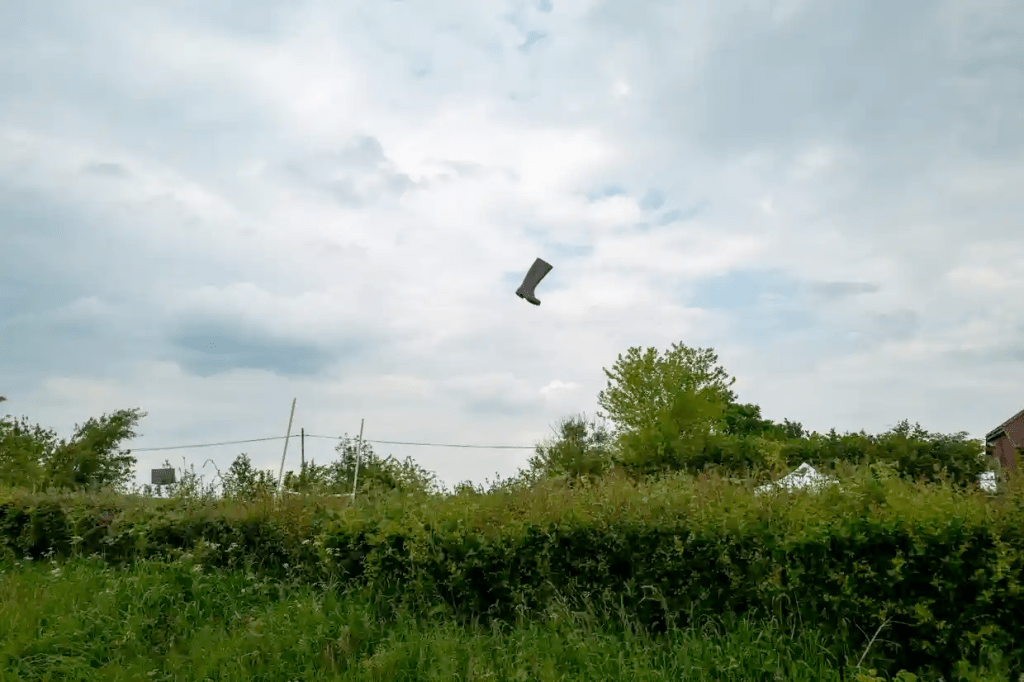
Photographer Elliott Erwin once said, “To me, photography is an art of observation. It’s about finding something interesting in an ordinary place … I’ve found it has little to do with the things you see and everything to do with the way you see them.” This quote is a mantra for photographer Alan Burles, who is constantly on the lookout for the odd in the everyday.
Above: Burles’s image of the “Welly Wanging Competition” in the village of Clifford, Herefordshire. Below: A serendipitous row of vans.
Writer Craig Mod writes here about the importance of walking—it’s his work, he says. He is a photographer as well as a writer, and carries all of his photography (and videography) equipment with him:
Depending on the day, I’ll walk anywhere from twelve to forty-five kilometers, carrying twelve kilos of photography and video equipment. I’ll interview several people each day, take portraits, photograph what “asks” to be photographed, sometimes record binaural audio, sometimes record video. I then arrive at the inn or hotel and settle in for some four to six hours of work / synthesis.
Both of these photographers write as if the photos are there, waiting to be found by the patient cameraman. The way they speak of their craft reminds me of Brendan O’Donnell’s excellent essay in the inaugural issue of my new zine Good Work:
The camera searches out land and buildings and trees beneath various kinds of weather. Structures groaning beneath the weight of use or neglect. People in various states of ignorance of the lens. Rights-of-way: railroads, rivers, roads; the vehicles upon them. That 50mm lens: if something is too far away, I can’t zoom in; I must walk or climb or drive closer. Sometimes I stay put and frame instead a faraway subject, but trains and rainsqualls will also obligingly close the distance. When the truck door is flung open, the spontaneity and urgency of the moment dictates that I bang the shutter a bunch of times in search of the thing I’ve seen. If time does not press on me, I hold the instrument at my chest, taking things in without technical mediation, and when I finally hit the shutter, I’ve made a more deliberate decision about what the tool sees. How the curve of that dirt road imitates the saddle in the hills above it. How the shadows cast from the poplars obliterate the detail in the wheat field beside them. How the low ceiling in the barroom hangs heavy over the shoulders of the man brooding over his drink.



 Christian Leithart