For nearly two centuries, we’ve embraced the relentless speeding up of communication by mechanical means, believing that the industrial ideals of efficiency, productivity, and optimization are as applicable to speech as to the manufacture of widgets. More recently, we’ve embraced the mechanization of editing, allowing software to replace people in choosing the information we see (and don’t see). With LLMs, the industrialization ethic moves at last into the creation of the very content of our speech.
Nicholas Carr
Category Archives: Quotes
Happy at Home
To be happy at home is the ultimate result of all ambition, the end to which every enterprise and labour tends, and of which every desire prompts the prosecution.
— Dr. Samuel Johnson, The Rambler, 1750
via
UPDATE – 6/26/25
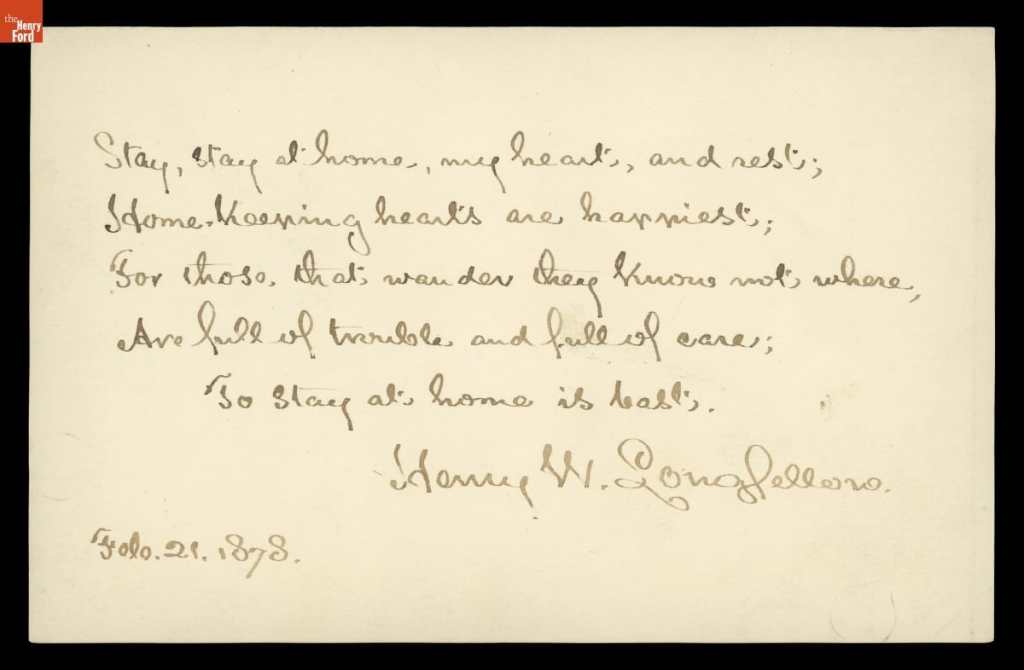
Henry Wadsworth Longfellow was often visited at home by fans, many of whom wanted his autograph. He wrote a short poem and had copies made so as to have a ready supply on hand. Here’s what he wrote:
Stay, stay at home, my heart and rest.
Home-keeping hearts are happiest.
For those that wander they know not where,
Are full of trouble and full of care,
To stay at home is best.

What Copyright is For
If you ask most people what copyright is for, they’ll tell you it’s about protecting artists. But that was never its goal. It was only meant to incentivise creative work by granting a temporary monopoly to its creator. By limiting control to a set period, the system was supposed to encourage production while guaranteeing that works would eventually enter the public domain for collective use. Case in point: when the US first implemented copyright in 1790 (inspired by similar laws in Britain), protection lasted just 14 years, with a one-time renewal for another 14. Early lawmakers saw copyright as a tradeoff – short-term exclusivity in exchange for long-term public access. As a federal appeals court put it in Authors Guild v. Google Inc. (2015), “while authors are undoubtedly important intended beneficiaries of copyright, the ultimate, intended beneficiary is the public.”
Elizabeth Goodspeed
AI Has Nothing to Communicate
As a working artist in his third decade of professional life, I’ve concluded that the point of art is to take a big, numinous, irreducible feeling that fills the artist’s mind, and attempt to infuse that feeling into some artistic vessel – a book, a painting, a song, a dance, a sculpture, etc – in the hopes that this work will cause a loose facsimile of that numinous, irreducible feeling to manifest in someone else’s mind.
Art, in other words, is an act of communication – and there you have the problem with AI art. As a writer, when I write a novel, I make tens – if not hundreds – of thousands of tiny decisions that are in service to this business of causing my big, irreducible, numinous feeling to materialize in your mind. Most of those decisions aren’t even conscious, but they are definitely decisions, and I don’t make them solely on the basis of probabilistic autocomplete. One of my novels may be good and it may be bad, but one thing is definitely is is rich in communicative intent. Every one of those microdecisions is an expression of artistic intent.
I’m reminded of Dorothy Sayers’ comments on the artistic act in The Mind of the Maker. Worth looking into.
Step Aside, Marianne
Etymonline is a can-opener, an imaginary labyrinth with real minotaurs in it, my never-written novel shattered into words and arranged in alphabetical order.
Doug Harper, founder of Etymonline
An Ambassador from the Transcendent World
Teacher: The modern world isn’t the only world there is, though. There is another world and it is at play right now—it’s a world behind the modern world, beneath it, beyond it—and you might need to walk around in this world “for more than ten minutes” in order to understand how things work there. [This book] is an artifact from this other world, and the way I’m interpreting it for you is a skill born of this other world. Every day during class, I do my best to present this world to you—to create entrances into it, so you can spend a little time there and see “how they do things there.” But, it’s difficult.
Student: Why?
Teacher: Because it’s not a physical place and I can’t force you to go there. It’s an intellectual place, a spiritual place, and the only way to enter this place is to genuinely want to be there—and you have to want to be there before you fully understand what it is.
Student: I’ve never heard anyone say anything like this before.
Teacher: That’s because it’s a bit alarming to hear it stated in such terms, even though it’s the most accurate way of describing it.
Student: What is it? What is this other world? Does it have a name?
Teacher: Yes. Your world, the modern world, is the immanent world. The other world is the transcendent world.
Student: And what’s your relationship to the transcendent world?
Teacher: As a classical teacher, I’m an ambassador of the transcendent world. My job is to present the transcendent world to you in such a way that you’ll want to take up residence there, be naturalized, and become a subject.
Obviously a conscious choice to use “subject” instead of “citizen” in the final sentence.
Present Laughter
To be conservative … is to prefer the familiar to the unknown, to prefer the tried to the untried, fact to mystery, the actual to the possible, the limited to the unbounded, the near to the distant, the sufficient to the superabundant, the convenient to the perfect, present laughter to utopian bliss.
Michael Oakeshott
FOMO
Even the definition of FOMO itself has started to change. For millennials, FOMO meant fear of missing out on what was happening in the real world: physical experiences and events other people were enjoying. Now it seems to mean fear of missing out on what’s happening online: notifications, memes, group chats, TikTok trends, Snapchat Stories. For Gen Z, FOMO isn’t a harm of social media; it’s a motivation to use it. It’s what traps young people on TikTok and Instagram. They fear being left out of social media itself.
Freya India
Precisely
Adventure and Hope
Adventure requires courage to keep us faithful to the struggle, since by its very nature adventure means that the future is always in doubt. And just to the extent that the future is in doubt, hope is required, as there can be no adventure if we despair of our goal. Such hope does not necessarily take the form of excessive confidence; rather, it involves the simple willingness to take the next step.
From Stanley Hauerwas, “A Story-Formed Community: Reflections on Watership Down“
