We can’t throw our hearts away. We can’t get a new heart, or at least we cannot get a new heart on our own. If I were to make a decision to throw my old heart away, that decision would have to be made by my old heart. And if my old heart could do something as wonderful as throwing my old heart away, what is the need for a new heart?
Douglas Wilson, Ploductivity
For by grace you have been saved through faith, and that not of yourselves; it is the gift of God…
Jack London claimed to write twenty hours a day. Before he undertook to write, he obtained the University of California course list and all the syllabi; he spent a year reading the textbooks in philosophy and literature. In subsequent years, once he had a book of his own under way, he set his alarm to wake him after four hours’ sleep. Often he slept through the alarm, so, by his own account, he rigged it to drop a weight on his head. I cannot say I believe this, though a novel like The Sea-Wolf is strong evidence that some sort of weight fell on his head with some sort of frequency — but you wouldn’t think a man would claim credit for it. London maintained that every writer needed a technique, experience, and a philosophical position.
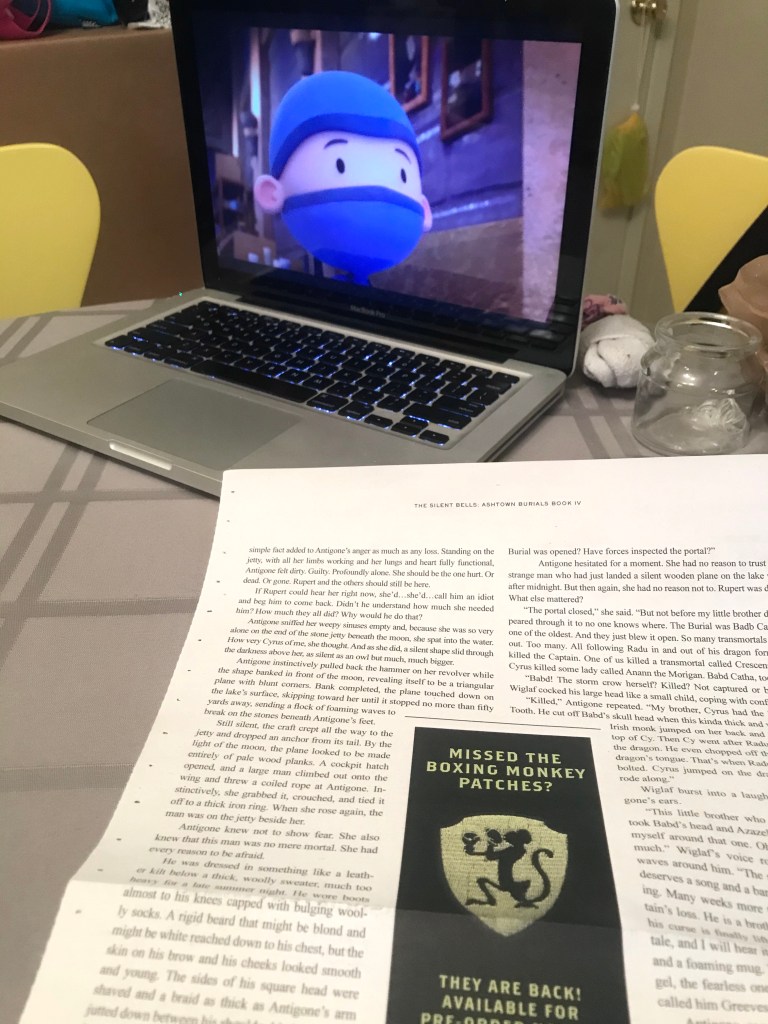
Lunch with NDW: Hello, Ninja on the tube, Ashtown on the rag
Nate Wilson taught me writing and rhetoric back in the day. For a long time, he was the only published author of fiction I knew, so I’ve always followed his doings with interest. With an output that includes ten novels, two non-fiction books, a feature film, two nature documentaries, and a Netflix show, he’s a tough guy to keep up with.
His latest endeavor is The Silent Bells, a young adult fantasy novel published on a monthly basis. Each chapter is mailed to subscribers in newspaper form (complete with funnies page and fake adverts). I’ve read most of Nate’s books, and I think this may be my favorite way to read them. His novels have lots of action and lush description that can be exhausting when you try to read a hundred pages at a go. At this new pace, the story is like drinking a Red Bull every four weeks. Not only that, his pacing shines even more, since you can’t just move on to the next chapter when you hit a (literal) cliffhanger. Gotta wait an entire month to find out how (if??) Cyrus will survive…
The late Thomas Roche, Jr. was a professor of English at Princeton. I know of him through his book The Kindly Flame, a commentary on Book III of The Faerie Queene. When he died a few months ago, several Princeton scholars assembled their memories of him, and I particularly love this one from Sarah Anderson:
On the day and at the hour, Tom entered the classroom and claimed the students’ attention: he bowed slightly, and he did not so much shrug his cloak from his shoulders, as twirl it slightly, so it reposed perfectly upon a chair. As he read, Spenser’s Merlin gleamed before us. The ligature between all that Tom knew — of Spenser, epic, Neoplatonism, a medieval and a newer world — was simply in Tom’s voice.
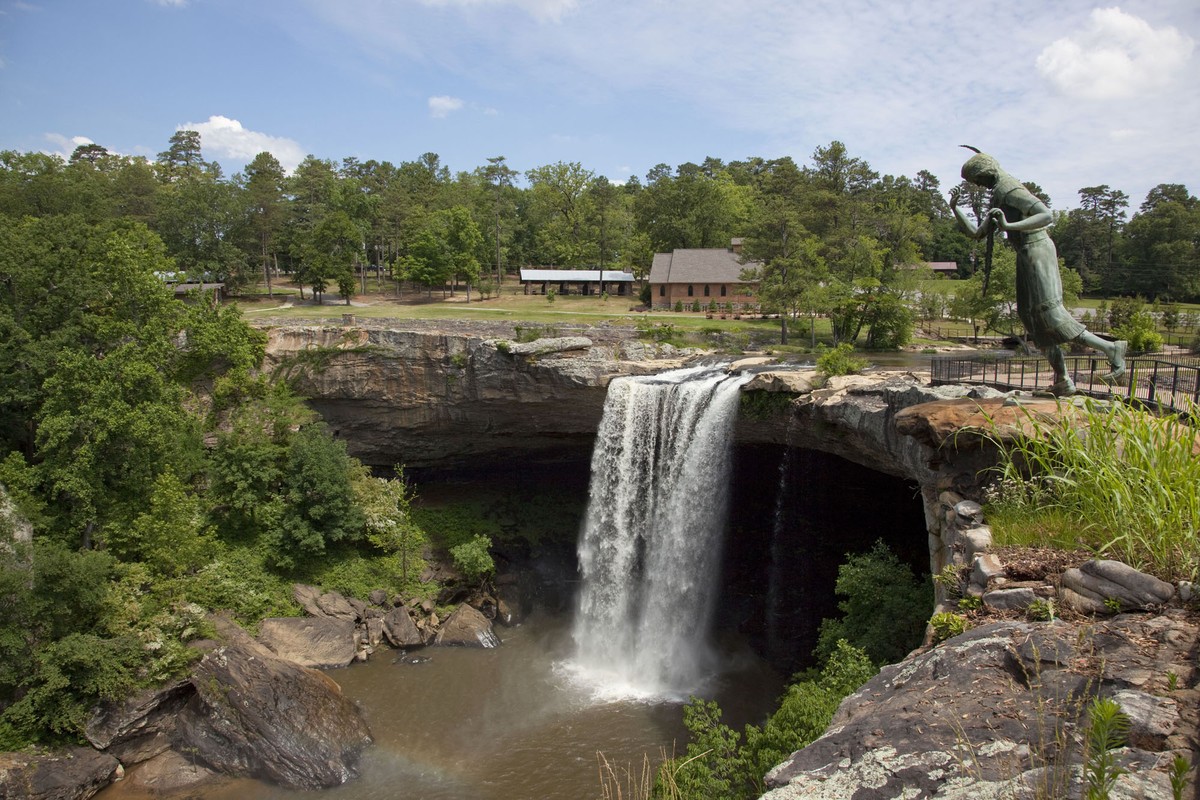
This picture of Noccalula Falls is one of fifty images of Alabama posted yesterday at the Atlantic. I live in a beautiful state, full of legends and rituals (most of the latter involving Nascar).
The first issue of my newsletter went out this morning, including a short essay I called “Writing in War-Time.” You can read it below, and, if you so desire, you can subscribe to the real deal here.
In 1939, almost two months after England declared war on Germany, C. S. Lewis gave a lecture about the importance of studying the humanities during a World War. Why waste time with such “placid occupations” as philosophy and literature, he asked, when men are dying in battle and the threat of invasion hangs over the nation?
We’re not in the middle of a World War, thankfully. But many of the same conditions that Lewis was concerned with exist today. A lot of people around the world are in very real danger, if not from the mysterious plague known as COVID-19, then from riots and civil unrest. It’s hard to read the headlines without dread. In such an environment, we may ask the same question Lewis poses: why spend time doing anything but the most essential activities?
Of course, what activities qualify as “essential” changes depending on who you ask (shopping? protest? worship?), but the question remains the same. In extreme circumstances, how do we justify wasting time on non-essentials? In Lewis’s lecture, “non-essentials” include studying the humanities. For me, they include writing children’s fiction and mulling over poetry while staring at the wall.
In his typical fashion, Lewis reframes the whole conversation. It’s wrong to ask whether studying (or writing) is the right thing to do in the middle of a war, he says, because the question assumes that war presents an unusual danger that must be met with an unusual response. The reality is that we are always in danger of our lives. None of us can be sure that he will be alive tomorrow. A better question, then, is whether studying or writing is ever the right thing to do. Why spend time reading Aristotle when you could be protesting? Why spend time writing poems when you could be saving souls? Why not do things that matter?
Lewis answers the question from many angles, but part of his answer is this: we waste time on “non-essentials” because we can’t help it. It’s human nature to play cards on the eve of battle. When city workers tore down a Confederate memorial in Birmingham in the middle of the night last week, they stopped for a pizza break. Even SWAT teams crack jokes on duty.
In the direst circumstances, people stubbornly remain people. They keep on humming, snickering, debating, reading, reciting, and contemplating. This means that they need good songs to hum, good jokes to laugh at, good ideas to debate, good books to read, good poetry to recite, and good art to contemplate. As Lewis says, “You are not, in fact, going to read nothing, either in the Church or in the [battle] line: if you don’t read good books, you will read bad ones. If you don’t go on thinking rationally, you will think irrationally. if you reject aesthetic satisfactions, you will fall into sensual satisfactions.”
Writing in the midst of pandemics and protests is, from the vantage point of eternity, not that different from writing at any other time. The only difference is that it’s much easier to get distracted. But the importance of the work remains unchanged. The world will have stories, and those of us who are blessed with the opportunity to write them must give the world good ones.
The world is calling us to action. But what should the artist do? Should artists set aside our pens and paintbrushes and pick up swords? The answer is far simpler and far more difficult. In times like these, the artist ought to stick to his work. Are you a chef? Make delicious food. Are you a musician? Play beautiful music. Are you a filmmaker? Capture moments in time. This present moment needs good works of art no more or less than any other, which means that it needs them vitally.
Human beings have overwhelmingly powerful cravings for novelty and unanimity. We want new problems to face, because we’re tired of the old ones: they bore us, and remind us of our failures to solve them. And, especially in times of stress, we crave environments in which dissent is silenced and even mere difference is erased. We call that “solidarity,” but it‘s more like an instinctual bullying. You must attend to the thing I am attending to. I despise both of those tendencies. They’ve turned everyone into attention muggers.

.jpg?bwg=1547468089)

 Christian Leithart