
.jpg?bwg=1547469031)




In this blog post, Alan Jacobs casually quotes Isaiah Berlin, Michael Oakeshott, Robert Conquest, W. B. Yeats, and Christopher Hitchens, and makes several references to George Orwell. I have benefited from Dr. Jacobs’s writing over the years primarily, I think, because of his incredible range of reading and the ease with which he can tie together disparate threads of thought. It’s a skill to aspire to.
What is teaching and why is it comic? The answer includes many things depending on whether you think of the teacher, the pupil, the means used, or the thing taught. But the type situation is simple and familiar. Think of a human pair teaching their child how to walk. There is, on the child’s side, strong desire and latent powers: he has legs and means to use them. He walks and smiles; he totters and looks alarmed; he falls and cries. The parents smile throughout, showering advice, warning, encouragement, and praise. The whole story, not only of teaching, but of man and civilization, is wrapped up in this first academic performance. It is funny because clumsiness makes us laugh, and touching because undaunted effort strikes a chord of gallantry, and finally comic because it has all been done before and is forever to do again.
Jacques Barzun, Teacher in America
I love Barzun’s description of this scene. That last sentence especially has a definite Chestertonian twang.
Barzun wasn’t the first to capture the poignancy of a child’s first steps. Rembrandt did it, too, in a simple sketch that artist David Hockney called “a perfect drawing.”
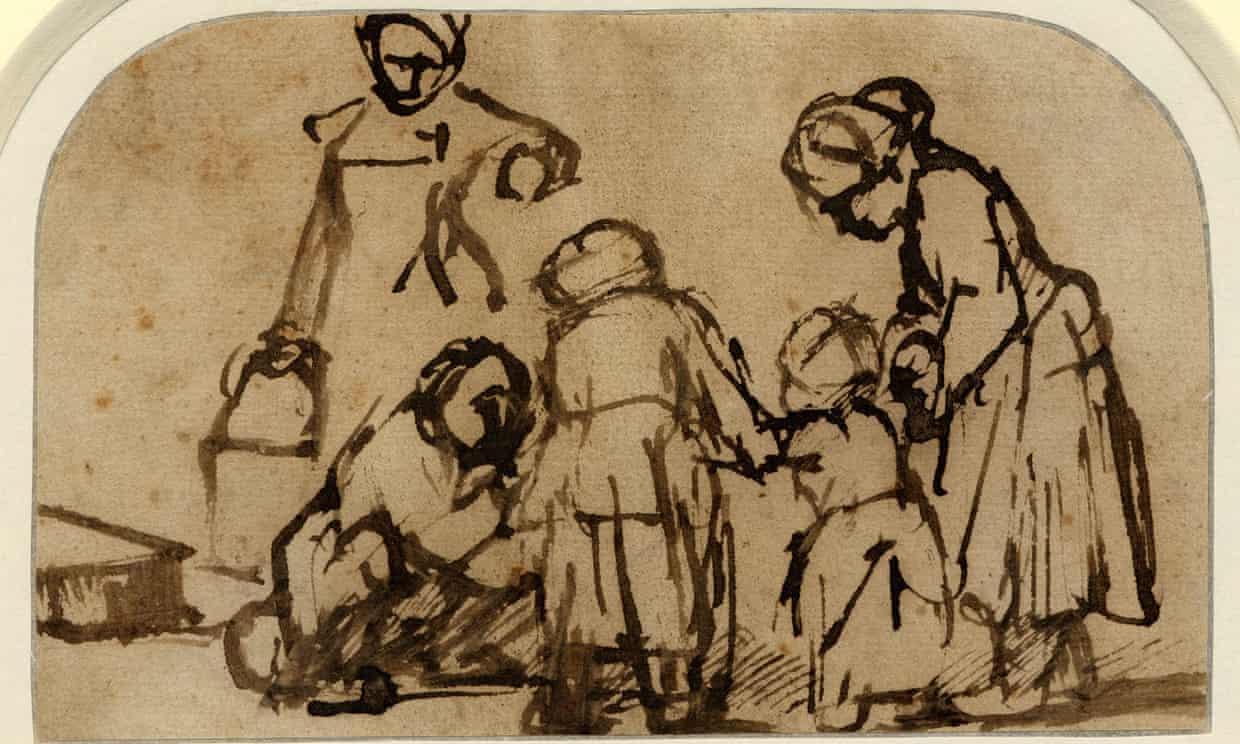
Rembrandt did several of these sketches, but Hockney is particularly taken with the one above. Here’s his explanation of its genius:
The child is being held by her mother and older sister. The mother grips the child firmly, the sister more hesitantly, and Rembrandt observes her looking at the child’s face to see how anxious she is. The lines of her shoulders beautifully indicate this; Rembrandt even turned his pen round and scratched through the ink to emphasise it. It makes me see the child’s face, a hint of worry in it, indicated only by one or two faint marks. One then begins to look at ink, not mothers and sisters, and marks made by a hand, speedily.
The trace of Rembrandt’s hand is still alive. Your eye can go back and forth between brown ink: sister; fast mark: mother. How rewarding this is, to move from the physical surface of the paper to its disappearance when you read the “subject”, and then back again. How many marvellous layers does this drawing have?
The mother has a double profile, Picassoesque. Was it an accident with the pen that he then used as a master would? Both profiles are fascinating about her character. Her skirt is a bit ragged, without any real detail; one seems to know this, and then marvels at how these few lines suggest it. Then, there’s a passing milkmaid, perhaps glancing at a very common scene, and we know the milk pail is full. You can sense the weight. Rembrandt perfectly and economically indicates this with – what? Six marks, the ones indicating her outstretched arm. Very few people could get near this. It is a perfect drawing.
From the time that the United States minted its first coins at the end of the 18th century until the beginning of the 20th century, every one of its coins featured either an abstract female or a Native American.
source
(HT Prufrock News)
I was and am convinced that the primary reason American Christians are so bent and broken is that we have neglected catechesis while living in a social order that catechizes us incessantly.
Alan Jacobs
 Christian Leithart
