I was surprised at the relief I felt on reading this. I’ve had dozens (scores?) of articles in my Pocket reading queue for probably ten years, all of which I’ve told myself I’ll “read later.” They’re about to vanish forever. Finally, I’ll be able to sleep at night.
No man appears in safety before the public eye unless he first relishes obscurity. No man is safe in speaking unless he loves to be silent. No man rules safely unless he is willing to be ruled. No man commands safely unless he has learned well how to obey. No man rejoices safely unless he has within him the testimony of a good conscience.
Jacob’s story, like David’s, is virtually unique in ancient literature in its searching representation of the radical transformations a person undergoes in the slow course of time. The powerful young man who made his way across the Jordan to Mesopotamia with only his walking staff, who wrestled with stones and men and divine beings, is now an old man tottering on the brink of the grave, bearing the deep wounds of his long life.
For nearly two centuries, we’ve embraced the relentless speeding up of communication by mechanical means, believing that the industrial ideals of efficiency, productivity, and optimization are as applicable to speech as to the manufacture of widgets. More recently, we’ve embraced the mechanization of editing, allowing software to replace people in choosing the information we see (and don’t see). With LLMs, the industrialization ethic moves at last into the creation of the very content of our speech.
To be happy at home is the ultimate result of all ambition, the end to which every enterprise and labour tends, and of which every desire prompts the prosecution.
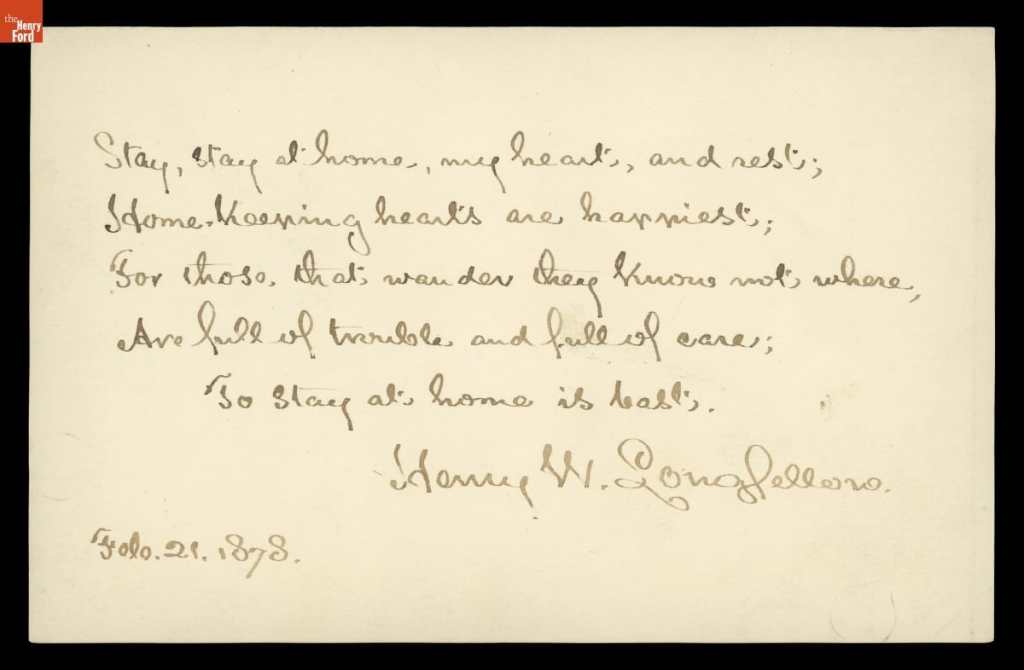
Henry Wadsworth Longfellow was often visited at home by fans, many of whom wanted his autograph. He wrote a short poem and had copies made so as to have a ready supply on hand. Here’s what he wrote:
Stay, stay at home, my heart and rest.
Home-keeping hearts are happiest.
For those that wander they know not where,
Are full of trouble and full of care,
To stay at home is best.
If you ask most people what copyright is for, they’ll tell you it’s about protecting artists. But that was never its goal. It was only meant to incentivise creative work by granting a temporary monopoly to its creator. By limiting control to a set period, the system was supposed to encourage production while guaranteeing that works would eventually enter the public domain for collective use. Case in point: when the US first implemented copyright in 1790 (inspired by similar laws in Britain), protection lasted just 14 years, with a one-time renewal for another 14. Early lawmakers saw copyright as a tradeoff – short-term exclusivity in exchange for long-term public access. As a federal appeals court put it in Authors Guild v. Google Inc. (2015), “while authors are undoubtedly important intended beneficiaries of copyright, the ultimate, intended beneficiary is the public.”
As a working artist in his third decade of professional life, I’ve concluded that the point of art is to take a big, numinous, irreducible feeling that fills the artist’s mind, and attempt to infuse that feeling into some artistic vessel – a book, a painting, a song, a dance, a sculpture, etc – in the hopes that this work will cause a loose facsimile of that numinous, irreducible feeling to manifest in someone else’s mind.
Art, in other words, is an act of communication – and there you have the problem with AI art. As a writer, when I write a novel, I make tens – if not hundreds – of thousands of tiny decisions that are in service to this business of causing my big, irreducible, numinous feeling to materialize in your mind. Most of those decisions aren’t even conscious, but they are definitely decisions, and I don’t make them solely on the basis of probabilistic autocomplete. One of my novels may be good and it may be bad, but one thing is definitely is is rich in communicative intent. Every one of those microdecisions is an expression of artistic intent.
I’m reminded of Dorothy Sayers’ comments on the artistic act in The Mind of the Maker. Worth looking into.
Etymonline is a can-opener, an imaginary labyrinth with real minotaurs in it, my never-written novel shattered into words and arranged in alphabetical order.


 Christian Leithart