Work Within Reach

Many of my posts here are generated by things that Alan Jacobs has posted about. One reason for this is that he posts a lot (despite having resolved, many times, to quit) and another is that his blog doesn’t have a Comments section, so if I want to respond, I have to do so here.

There’s also something about the way Jacobs writes that prompts reflection. I think his great strength as a writer (and probably as a teacher) is his ability to pull together ideas from many different sources and put them side by side. As far as I can tell, this doesn’t require a photographic memory. He’s just a very careful reader. Here’s what a page looks like after he’s read it:

I always come away from a Jacobs post or book itching to read the authors he writes about. He truly does have a gift for presenting their ideas clearly.

In one recent post, Jacobs described his “great project”/”glorious endeavor” (somewhat tongue in cheek): a college Where the New Liberal Arts Meets the Old. One of his foundational courses would be the Care of Plants and Animals, an idea he cheerfully stole from Auden’s “daydream College for Bards.” Here’s Auden’s full description:

In my daydream College for Bards, the curriculum would be as follows:

(1) In addition to English, at least one ancient language, probably Greek or Hebrew, and two modern languages would be required.

(2) Thousands of lines of poetry in these languages would be learned by heart.

(3) The library would contain no books of literary criticism, and the only critical exercise required of students would be the writing of parodies.

(4) Courses in prosody, rhetoric and comparative philology would be required of all students, and every student would have to select three courses out of courses in mathematics, natural history, geology, meteorology, archaeology, mythology, liturgics, cooking.

(5) every student would be required to look after a domestic animal and cultivate a garden plot.

A poet has not only to educate himself as a poet, he has also to consider how he is going to earn his living. Ideally, he should have a job which does not in any way involve the manipulation of words. At one time, children training to become rabbis were also taught some skilled manual trade, and if only they knew their child was going to become a poet, the best thing parents could do would be to get him at an early age into some Craft Trades Union. Unfortunately, they cannot know this in advance, and, except in very rare cases, by the time he is twenty-one, the only nonliterary job for which a poet-to-be is qualified is unskilled manual labor. In earning his living, the average poet has to choose between being a translator, a teacher, a literary journalist or a writer of advertising copy and, of these, all but the first can be directly detrimental to his poetry, and even translation does not free him from leading a too exclusively literary life.

From Auden’s The Dyer’s Hand, an excellent book. I found this passage online here.

Number 5, which I put in bold, would also be a feature of Jacobs’ Cassiodorus College. I’m struck by this emphasis on gardening as a fundamental part of a good education, especially when paired with Wendell Berry’s essay on the dead-end worldview that is Global-Thinking. The only way to “make ecological good sense,” as he puts it, is to focus on what’s in front of you:

The right scale in work gives power to affection. When one works beyond the reach of one’s love for the place one is working in, and for the things and creatures one is working with and among, then destruction inevitably results. An adequate local culture, among other things, keeps work within the reach of love.

“Out of Your Car, Off Your Horse,” originally published in the Atlantic

Besides the connection to Good Work (a new zine that you should subscribe to), I think this passage is important because Berry and Auden both emphasize working with one’s hands on things that are literally within reach. What benefit does gardening have to education and building a culture? I could rope in Matthew Crawford and Robert Farrar Capon here, but I’m worried this post is getting too dense as it is, so I’ll summarize two ways that manual labor can educate a person:

  1. Using your hands makes you aware of your own limits, both physically and in terms of your ability. A bell pepper exists independently from you. It’s easy to forget that kind of thing when you spend all day in a classroom.
  2. Gardening and caring for animals makes you aware, in a palpable sense, of time. You can’t grow a tomato in an instant. If you did, it wouldn’t be a tomato. A yearling calf is a year old (roughly). Again, it’s easy to forget, when you sit around a table with other brainiacs, that good work can’t be accomplished in an instant.

Gibbs on How to Save Classical Christian Ed

First, get tougher admissions standards. Start asking prospective parents: How do you discipline your children? Do your daughters have smartphones and social media accounts? Do your sons play video games? Do you go to church every Sunday? Do you eat dinner as a family most nights of the week? Do you want your children to change the world? Are your children special? Do a survey of your best teachers and ask them what common cultural attributes are shared by the worst students they have. Use a little common sense. Don’t let more families into your school which have a lot in common with the most vexing, worldly families already there.

Second, work on your faculty culture. If you can’t offer teachers a compelling salary, you have to offer them a compelling faculty culture. Hire substitutes, give your language department a couple bottles of good scotch, and tell them to just spend the day chatting. Culture revolves around food and drink and singing and dancing. If your faculty doesn’t do these things together regularly, you don’t actually have a faculty culture.

Third, make a concerted effort to not let board member’s kids, teacher’s kids, or rich kids get away with murder. You know which students ought to have been kicked out years ago. Kick them out. A classical Christian school is a bit of a ministry and a bit of a business, but bad administrators have a tendency of dicing up the ministry and business aspects of a school so that teachers always get the short end of the stick. Faculty salaries? It’s a ministry. Badly behaved board member’s kids? It’s a ministry. Massive sports program? It’s a business. No matter which way they turn, the business/ministry dichotomy leaves teachers with less: less money, less time, less freedom, less peace, less respect. If you don’t want a Great Tradition school to open in town and soak up all your best teachers, start asking yourself how’d you treat faculty differently if there was a Great Tradition school in town that could beat your salary offering by 5%.

Fourth, take a survey of where your families go to church, then take a survey of where your faculty go to church. On a scale of 1 to 10, where 1 means Sponge.TV Faith Café and 10 means St. Prude’s Catholic, if your average family is a 3 and your average teacher is a 7, mission drift is a huge problem at your school and the only way to fix it is to completely overhaul your admission’s process.

Finally, every teacher needs a hero, but every school needs a hero, as well. Every school ought to have a school in mind that it is striving to be like. At the moment, classical Christian schools too often compare themselves with the non-classical Christian schools in town and generally come away feeling quite pleased at their accomplishments. Quit comparing your school with schools that aren’t even trying to do the same thing. Find classical Christian schools (and colleges) that are better than yours and start making the painful changes necessary to become like them.

Source

Spenser Links

I may be the only person on Earth who has a Google Alert for “edmund spenser,” so I may be the only person who knows just how rarely his name is invoked in the English-speaking world. Occasionally, a rare “Una and the Lion” coin will go to auction, and every Valentine’s Day there are multiple blogs posting snippets of “Amoretti,” but ninety percent of the time, there’s nary a peep.

Once in a while, however, Spenser’s name does survive the editor’s axe. I used to post these references on my Edmund Spenser blog, but as I rarely use that site these days, I thought this was a more appropriate venue.

First, and most randomly, here he is quoted in the bridge column of the Hastings Tribune: “So double was his pains, so double be his praise.”

The website Hogwarts Professor wrote a much-deserved tribute to the great scholar Alastair Fowler, who edited CS Lewis’s book Spenser’s Images of Life, and who also shared my hatred of “new historicism.”

Exaudi, an album of choral music by Christopher Fox, contains a song based on Prothalamion:

A Spousal Verse (2004), written for the Clerks, is a harmonically rich setting of the sixth stanza of Prothalamion (1596), by the Elizabethan poet Edmund Spenser. Fragments of melody are interwoven into brief contrapuntal units. Birds, Venus herself, and Peace are implored to bless the wedding, with the last verse serving as a refrain: ‘Upon your Brydale day, which is not long: Sweete Themmes run softlie, till I end my Song.'”

A brief overview of the Poet’s Corner in Westminster Abbey must include a mention of Spenser, of course.

Rowan Ricardo Phillips, poet, modeled a poem after the stanza form invented by Spenser. Here’s Jesse Nathan’s description in McSweeney’s:

His first book of poems, The Ground, starts with an ancient newness, a nine-line stanza repurposed from Edmund Spenser, who had used it in Renaissance England before Shakespeare was a name anyone knew. Phillips’s oeuvre begins in this way, and you aren’t meant to have to immediately hear the Spenser; that’s part of the point, that the traditions flow under the lines like an unseen river, unseen but profoundly there, not obscuring what’s on the surface but feeding it:

In the beginning was this surface. A wall. A beginning.
Tonight it coaxed music from a Harlem cloudbank. It freestyled
A smoke from a stranger’s coat. It stole thinned gin.
It was at the edge of its beginnings but outside
Looking in. The lapse-blue façade of Harlem Hospital is weatherstill
Like a starlit lake in the midst of Lenox Avenue …

It was this poem, published in 2012, that announced the emergence of a major talent. Willing to draw on all the available resources, willing to cull and reject and amplify—this, the work seemed to be saying, is an urgent poetics of inventive reinvention.

Fun!

In the Cinemaholic, Diksha Sundriyal muses on the source of the enigmatic phrase “What is lost will be found” in Netflix’s show 1899:

There are two instances where this phrase appears in some form in the real world, and their context helps us understand what it might mean for Maura and the passengers. The first is the poem, ‘The Faerie Queene’ by Edmund Spenser. One of the longest poems in English literature, it follows the stories of several knights while also talking about the reign of Queen Elizabeth I. While one can take it at its face value, the poem is known for being full of allegories, with different layers to its verses.

One of the lines in the poem’s ‘The Ways of God Unsearchable‘ part reads: “For whatsoever from one place doth fall/ Is with the tide unto an other brought/ For there is nothing lost, that may be found if sought.” The last line bears some resemblance to the phrase Maura finds on the envelope. These lines talk about the place of things and how they always surface no matter how deep they are buried. If something has disappeared from its place, then it will show up somewhere else one way or another in some form. And no matter how elusive it might be, if you look for it long enough, you will eventually find it.

Last, Rebecca Reynolds has announced an interesting project: a prose “translation” of the entire Faerie Queene. In a post at the Rabbit Room, she explains:

I’ve spent the past four years working with Renaissance scholars to create a line-by-line, text-faithful prose rendering of Spenser’s work. I’ve included many footnotes referencing Spenserian scholars while offering a version of the text that allows readers to move easily through the plot. My goal isn’t to replace Spenser’s original work—that would be impossible—but to provide a transitional work that gives modern readers the confidence to tackle the original.

She also has a great (longish) introduction to Spenser and the Faerie Queene on her website. And be sure to check out the awesome illustrations.

The Art of Observation

Photographer Elliott Erwin once said, “To me, photography is an art of observation. It’s about finding something interesting in an ordinary place … I’ve found it has little to do with the things you see and everything to do with the way you see them.” This quote is a mantra for photographer Alan Burles, who is constantly on the lookout for the odd in the everyday.
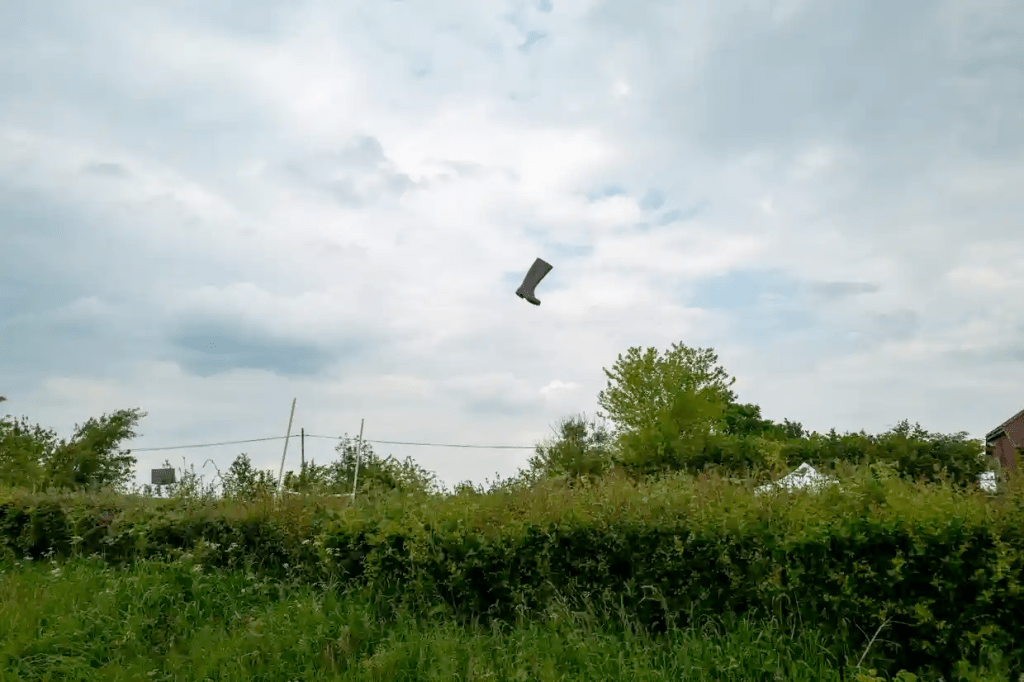
Above: Burles’s image of the “Welly Wanging Competition” in the village of Clifford, Herefordshire. Below: A serendipitous row of vans.

Writer Craig Mod writes here about the importance of walking—it’s his work, he says. He is a photographer as well as a writer, and carries all of his photography (and videography) equipment with him:

Depending on the day, I’ll walk anywhere from twelve to forty-five kilometers, carrying twelve kilos of photography and video equipment. I’ll interview several people each day, take portraits, photograph what “asks” to be photographed, sometimes record binaural audio, sometimes record video. I then arrive at the inn or hotel and settle in for some four to six hours of work / synthesis.

Both of these photographers write as if the photos are there, waiting to be found by the patient cameraman. The way they speak of their craft reminds me of Brendan O’Donnell’s excellent essay in the inaugural issue of my new zine Good Work:

The camera searches out land and buildings and trees beneath various kinds of weather. Structures groaning beneath the weight of use or neglect. People in various states of ignorance of the lens. Rights-of-way: railroads, rivers, roads; the vehicles upon them. That 50mm lens: if something is too far away, I can’t zoom in; I must walk or climb or drive closer. Sometimes I stay put and frame instead a faraway subject, but trains and rainsqualls will also obligingly close the distance. When the truck door is flung open, the spontaneity and urgency of the moment dictates that I bang the shutter a bunch of times in search of the thing I’ve seen. If time does not press on me, I hold the instrument at my chest, taking things in without technical mediation, and when I finally hit the shutter, I’ve made a more deliberate decision about what the tool sees. How the curve of that dirt road imitates the saddle in the hills above it. How the shadows cast from the poplars obliterate the detail in the wheat field beside them. How the low ceiling in the barroom hangs heavy over the shoulders of the man brooding over his drink.

Sign up for Good Work here.

(HT to Alan Jacobs’s newsletter for both linked articles above.)

What I Read in 2022

Read Alouds (18)

  • Ramon Quimby, Age 8, Beverly Cleary – A very dreary book, but Cleary still does what she does best: capturing life through a child’s eyes.
  • Half-Magic, Edward Eager – A favorite. The plotline about magic transitions into the plotline about family so smoothly it feels natural. And it’s refreshing to read a book where the children need a grown-up to come in and sort everything out.
  • Magic by the Lake, Edward Eager – Not as good as Half-Magic. Most of the adventures are based on other books, which feels like cheating, and they feel very disconnected.
  • The Borrowers, Mary Norton – Surprisingly thick descriptions. Norton seems to have taken pains over her writing. The story is good, but the ending may be unsatisfying to younger readers.
  • Flat Stanley, Jeff Brown – My father read this to us years ago and it stuck with me. My daughter seemed to enjoy it, too, though I hope not too much. I’d hate to find her on the floor under towering stacks of the Encyclopedia Britannica.
  • The Princess and the Goblin, George MacDonald – A great old-fashioned tale.
  • The Horse and His Boy, C. S. Lewis – The first half is edge-of-your-seat great. The second half plods a little.
  • Hank the Cowdog: The Case of the Halloween Ghost, John R. Erickson – I was worried the whole “unreliable narrator” thing would go over my five-year-old’s head, but she enjoyed my Hank and Drover voices too much to care.
  • Because of Winn-Dixie, Kate DiCamillo – One reviewer said each chapter is structured like a short story, which is true: beginning, middle, end. The overall book is a mixed bag. Too simple for adults, too slow for children.
  • The Story of Doctor Dolittle, Hugh Lofting – Charming, but loosely plotted. I started with the 1948 edition and realized partway through I was going to have to navigate some pretty on-the-nose racism. Thankfully, the publisher, assisted by the author’s son, revised it 1988. The worst scene, when the Doctor turns Prince Bumpo’s skin white so that he will let them out of jail, was rewritten so that Polynesia simply hypnotizes the Prince. It falls flat, but they did their best. I hear the second Dolittle book is better than the first.
  • Winnie-the-Pooh, A. A. Milne – I enjoyed this more as an adult than I did as a child. The characters are petty and small-minded, for the most part, but Milne is usually able to portray them affectionately. At times, Pooh reminded me of Freddy the Pig. I wonder if there’s some connection there.
  • The House at Pooh Corner, A. A. Milne – For the most part, the stories are more tightly plotted than in the original. Piglet’s selfless act at the end always gets me, especially because it is immediately followed by another selfless act by Pooh. The very end, with Christopher Robin and Pooh at the beautifully named Galleons Lap, just barely stays this side of saccharine. But it does.
  • The Light Princess, George MacDonald – C. S. Lewis said that MacDonald was a modern-day mythmaker. I don’t think I’ll ever forget the bizarre scene of the snake drinking the lake dry by sucking on a stone teat. Bizarre.
  • Mr. Popper’s Penguins, Richard and Florence Atwater – An old favorite.
  • Treasures of the Snow, Patricia St. John – One of my favorites. Her portrayal of bitterness reminded me strongly of Lewis’s fiction.
  • Misty of Chincoteague, Marguerite Henry – Some good scenes, but not great.
  • Freddy Goes to the North Pole, Walter R. Brooks – You either love the Freddy the Pig books or you just don’t get them at all. My daughter, I’m happy to say, loved this one.
  • The Courage of Sarah Noble, Alice Dalgliesh – Short and simple.

Children’s Fiction (13)

  • Moon Over Manifest, Clare Vanderpool – Felt like the kind of novel that would get you an agent but not a publisher, if you know what I mean.
  • Danny the Champion of the World, Roald Dahl – A lot of Dahl’s books have a mean streak, especially against adults. This one, the story of a boy who learns his dad poaches pheasants from a nearby estate, is legitimately heartwarming.
  • Across the Desert, Dusti Bowling – Forgettable.
  • Scythe, Neal Shusterman – Craft-wise, better than Unwind, but the characters were less likeable and the plot more unbelievable.
  • Word to Caesar, Geoffrey Trease – A zippy adventure with just enough historical detail to make it interesting. Henty-lite.
  • The Iron Tsar, Geoffrey Trease – Very similar to Word to Caesar. The characters are flat, but the plot moves. This guy could easily have been a screenwriter.
  • The Sinking City, Christine Cohen – Another good adventure from Canonball Books. The world-building in this one is first-rate.
  • The Penderwicks on Gardam Street, Jeanne Birdsall – I enjoyed this one much more than the first book.
  • The Boy and the River, Henri Bosco – Short and sensual. The descriptions of the river and its flora and fauna are so luxuriant they border on suffocating. I couldn’t help wondering if the touch is lighter in French. Posted a quote here.
  • The White Stag, Kate Seredy – Read like a fairy tale. I now know more about Huns and Magyars than I used to.
  • Henry Reed, Inc., Keith Robertson – A thirteen-year-old boy spends his summer in a sleepy town in New Jersey. Most novels that start this way continue with the boy discovering magic, solving a mystery, or making friends with a crotchety neighbor. Henry Reed starts a business. (This is one of the only kids’ novels I know about free enterprise.) The book is written in the first person, in the form of journal (not diary) entries, which provides a lot of humor. Henry is interested in almost everything, is smart and inventive, and is almost completely ignorant of how he comes across. It’s very amusing. I’d enjoy a chapter written from Midge’s perspective.
  • Hatchet, Gary Paulsen – When I was young, I somehow got the idea that this was a bad book. It does have divorce, heart attacks, starvation, diarrhea, moose attacks, and a dead body. But it’s not bad.
  • The Golem’s Eye, Jonathan Stroud – I enjoyed The Amulet of Samarkand, the first book in the Bartimaeus trilogy, but this one just didn’t do it for me.

Teaching (7)

  • Assigned for class: Aeneid, Virgil (translated by Stanley Lombardo); Watership Down, Richard Adams (what a book); Prince Caspian, C. S. Lewis; Gilgamesh the Hero, Geraldine McCaughrean; The Golden Fleece, Padraic Colum
  • Responsive School Discipline, Chip Wood and Babs Freeman-Loftis – Practical.
  • Norms and Nobility, David V. Hicks – People in my circles don’t talk about this book, but they need to.

Theology and the Christian Life (15)

  • A Grief Observed, C. S. Lewis – My third or fourth time through. Lewis was such a keen observer of humans, he’s insightful even at his most raw.
  • Papa Don’t Pope, Douglas Wilson – Surprisingly good. This felt like his older books—more gracious and less joking. Almost every chapter starts with some variation of “So I was talking to a Catholic friend of mine…”
  • Treasure in Clay Jars, edited by Lois Y. Barrett – An examination of the qualities that make a church “missional.” The authors (six of them) have a low standard of orthodoxy, but the qualities themselves are inarguable: Missional vocation; Biblical formation and discipleship; Taking risks as a contrast community; Practices that demonstrate God’s intent for the world; Worship as public witness; Dependence on the Holy Spirit; Pointing toward the reign of God; Missional authority.
  • The Peacemaker, Ken Sande – A helpful book about how Christians ought to resolve conflict.
  • Solomon Says, Mark Horne – Gives a helpful structure of Proverbs and draws out a few key insights.
  • Finding God at Home, Ernest Boyer, Jr. – A mix of good and bad.
  • Confessing the Faith, Chad VanDixhoorn – A helpful commentary on the Westminster Confession.
  • Hints on Child-Training, H. Clay Trumbull – Very good.
  • Mother Kirk, Douglas Wilson – A very solid handbook of church life and ministry. From my perspective, this is a sort of background text for a lot of what I did growing up.
  • Letters to Malcolm, Chiefly on Prayer, C. S. Lewis – Josh Gibbs once said that C. S. Lewis was a better anthropologist than theologian, and this book is a perfect example. His descriptions of the experience of prayer are great, as are his descriptions of the personality of the One we pray to, but the more theological claims made me wince. For example, to Lewis, the bodily resurrection apparently means the sensory resurrection, despite what the disciples saw and heard and felt when Christ walked through the wall. I’m surprised so many of my friends like this book so much.
  • Seven Days that Divide the World, John C. Lennox – An unusual book in some ways. The main point of the book is that Genesis isn’t specific enough to definitively prove the Young Earth position, so we should rely on scientific evidence, which supports the Old Earth position. Lennox’s argument relies on the historical debate between geo- and heliocentrism. Back then, he says, Christians eventually admitted, in the face of scientific evidence, that Earth was not fixed at the center of the solar system. The Bible passages that seem to support that concept were judged to be metaphorical. So it is with Young vs. Old Earth, and Christians need to stop being so stubborn about it. Lennox isn’t trying to rewrite Scripture, however. He takes the historic Christian position on the creation of Man (no ape ancestors here) and the death and resurrection of Christ. He wants to say no more and no less than the text. I appreciate that he takes this seriously and would love to see more books like this, but I have quibbles. For example, in arguing for scriptural agnosticism on this issue, Lennox is de facto taking an Old Earth position. There is no other reason to throw away centuries of Christian writing on the subject. I was reminded of a Sunday school class at a church I once attended which was meant to “explore the question of whether women should be elders.” Needless to say, the teacher had already decided that they should. He just needed to appear impartial in order to convince us.
  • Help for the New Pastor, Charles Malcolm Wingard – The word that comes to mind reading this book is “humble.” A simple guide for young pastors on what the ministry entails.
  • The Ruthless Elimination of Hurry, John Mark Comer – So trendy it was hard to stomach—”mindfulness,” “minimalism,” “follower of Jesus” (instead of “Christian”). I read it with a few friends, and when we met to discuss it, I was surprised to learn how much they both liked it. I guess it depends on where you’re coming from.
  • Gashmu Saith It, Douglas Wilson – A few good bits, but man, what a terrible title.
  • Decluttering Your Marriage, Douglas Wilson – I’d heard most of this before, in one form or another. I did like his point about correcting others. We prefer to ignore the sins of others when they aren’t getting on our nerves; it’s only when they start to annoy us that correcting them suddenly seems to be of the utmost importance. Unfortunately, that’s when we’re least qualified.

Adult Fiction (9)

  • Scaramouche, Rafael Sabatini – Action-packed and fun, but a little too long.
  • The Wind in the Willows, Kenneth Grahame – A beautiful book. It has its fans and its haters, and I understand both reactions. But the haters are wrong.
  • The Alto Wore Tweed, Mark Schweizer – Some downright terrible writing. But ecclesiastical humor always gets me.
  • Casino Royale, Ian Fleming – I was pleasantly surprised. Bond is disgusting, of course, but Fleming was able to make him human, too. The writing as a whole was not great, but occasionally Fleming caught me off guard with a particularly vivid sentence like this one: “He pushed the revs up and up, hurrying the car to eighty then to ninety, his huge Marchal headlights boring a safe white tunnel, nearly half a mile long, between the walls of the night.” Exactly the mix of poetry and pulp that you want in a spy thriller.
  • The Long Goodbye and The Big Sleep, Raymond Chandler – I read these in reverse order. Marlowe is much more sour in TLG; in TBS he seems positively chipper by comparison.
  • On Beauty, Zadie Smith – Smith is brilliant at creating characters and building scenes (funny, tender, awkward, tense, you name it). I’m not sure she’s very interested in plot, however.
  • Going Postal, Terry Pratchett – This was my third or fourth Pratchett and I’m finally starting to see the appeal. It helped that this one is about a reformed con man doing his best to save the outdated Ankh-Morpork post office. I’m a sucker for stories of people doing the right thing when the right thing is all but impossible.
  • Dune, Frank Herbert – Fine, but I don’t see what all the fuss is about.

Non-Fiction (15)

  • The Years with Ross, James Thurber – All the humor of the New Yorker’s early years with Harold Ross as editor-in-chief. Some of the jokes were a bit too inside-baseball, but Thurber can really do one-liners.
  • An Experiment in Criticism, C. S. Lewis – Lots to chew on.
  • The Checklist Manifesto, Atul Gawande – A doctor I know told me that this is a controversial book in the medical community. I don’t know why. Gawande makes a strong case.
  • In the House of Tom Bombadil, C. R. Wiley – Some very good insights. I need to read LOTR again.
  • The Household and the War for the Cosmos, C. R. Wiley – Reading this felt like riding in the front seat of Wiley’s truck as he drove through a familiar town, making turns at random and occasionally doubling back on himself, pointing out various details, some of which were interesting, but most of which others had shown me a long time ago. In other words, my takeaway was a mix of “I’ve seen this before” and “Where did that come from?”
  • It’s Good to Be a Man, Michael Foster and D. Bnonn Tennant – Real bad.
  • Made to Stick, Chip Heath & Dan Heath – Very helpful for thinking about mission statements.
  • The End of the World is Just the Beginning, Peter Zeihan – Others have praised and critiqued this book, so I’ll just give my impressions: 1) Zeihan views the world through geographic and demographic lenses, paying particular attention to economies and resources. I’m really glad he does because I don’t, and someone ought to. 2) Because of the above, he misses a lot of what makes people tick. Not everyone goes to war because he’s hungry.
  • How to Think, Alan Jacobs – I’m familiar enough with Jacobs’s writing that not much in this book was new to me. I did think many times, however, of certain acquaintances of mine and how stubborn they can be in their thinking, especially online.
  • How to Keep House While Drowning, K. C. Davis – This is the kind of book I’ll forget that I read in a few years.
  • The Accidental Superpower, Peter Zeihan – Provides some necessary political background for The End of the World. Specifically, it helped me understand why Zeihan is so sure the US will withdraw from the global scene in the next few decades.
  • The Weight of Glory, C. S. Lewis – Very good. I listened to the audiobook, so I didn’t take a lot of notes.
  • Deep Work, Cal Newport – One of the most immediately useful books I’ve read in a while.
  • Creativity, Inc., Ed Catmull – Another audiobook, so I can’t remember a ton, but there were a lot of good ideas here.
  • The Half-Acre Homestead, Lloyd Kahn and Lesley Creed – A photographic tour of the authors’ home, garden, and studio, with commentary in the margins. Read kind of like a blog, with 46 years of experience behind it.
  • Hiroshima, John Hersey – Gut-wrenching.

Comic Books and Graphic Novels (1)

  • Pearls Sells Out, Stephan Pastis

Plays (7)

  • Pride and Prejudice, Janet Munsil
  • Pride and Prejudice, Helen Jerome
  • Medea, Alcestis, and The Bacchae, Euripides – Three plays included in Adler’s Great Books. All odd in their own ways. Medea contains an extremely unpleasant, though understandable, protagonist. Alcestis has all the ingredients for a tragedy, but ends happily, thanks to Heracles. The Bacchae is nightmarishly violent, but also portrays a witty and charismatic Dionysus. More than most Greek playwrights, Euripides seems like he would have been at home in the 20th century world of theater.
  • The Mousetrap, Agatha Christie
  • Witness for the Prosecution, Agatha Christie

Poetry (1)

  • Poetry I, ed. Richard Corbin

Total: 86

Average is the New Zero

As a follow-up to the most recent Scriptnotes, John August wrote a blog post that included one listener’s response:

Language models are built on “training data,” which is the text you feed into a learning process to produce the output. For very sophisticated models, the training data is vast: for something like ChatGPT, it includes something like all the text you can scrape off of the last twenty years of the Internet, or so.

But this means ChatGPT is about as smart as the average writer on the Internet has been over the past twenty years — and indeed, the models that comprise GPT drag the results toward the average, not the extraordinary, because the average has much nicer statistical properties than the extraordinary for companies that seek to produce a marketable, scalable product from their models, which requires the ability to tweak, diagnose, and defend what you’re selling.

Ultimately what these models mean is that with the click of a button you can now be just as good as the average writer who posts content to the Internet, and so the old “average” is now the new “zero.” If you wrote at the average level of the Internet in 2022 you now write at the zero level.

Emphasis in original

Unhinged

[Eco] uses Dumas’ The Count of Monte Cristo, Dante’s Divine Comedy, Shakespeare’s Hamlet, and Curtiz’s Casablanca to show that cult classics are cults “precisely because they are basically ramshackle, or ‘unhinged,’ so to speak.” It’s their imperfectness, the disjointed parts, that gives fans something to attach to, something to remember, something to cite.

Donna Haraway via Robin Sloan via (who else) Alan Jacobs

I sense this same quality in The Faerie Queene, which is why, when it gets its hooks in you, it doesn’t let go. As C. S. Lewis once said, “I’ve never met a man who used to like the Faerie Queene.”

Hurrying Through Leisure

The whole attitude seems to be: Let me get through this thing I don’t especially enjoy so I can do another thing just like it, which I won’t enjoy either. This is precisely what Paul Virilio means when he talks about living at a “frenetic standstill” and what Hartmut Rosa means when he talks about “social acceleration.” 

I say: If you’re trying to get through your work as quickly as you can, then maybe you should see if you can find a different line of work. And if you’re trying to get through your leisure-time reading and watching and listening as quickly as you can, then you definitely do not understand the meaning of leisure and should do a thorough rethink. And in both cases maybe it would be useful to read Mark Helprin on “The Acceleration of Tranquility.”

Alan Jacobs

This reminds me of two things, both of which I probably learned about from Jacobs.

Odyssey XIV

The part of Book XIV that always gives students pause is the poet’s sudden direct address: “And, you, Eumaeus, my noble swineherd,” etc. Peter Jones says that the figure of speech, apostrophe, is reserved for characters whom, for whatever reason, the poet has particular affection for. In the Iliad, it is used for Patroclus and Menelaus, while in the Odyssey, only Eumaeus is addressed that way.

Odysseus is, of course, the great hero of the Odyssey, and Telemachus and Penelope match his qualities in their own ways. But if you’re looking for a character who is truly good, Eumaeus is your man. He is courageous, hospitable, intelligent, and, most of all, loyal. I can imagine him being used allegorical as an example of a Christian: faithfully tending his Lord’s flocks until the day of return.

Odyssey XIII

I’ve decided to start sharing my notes and reading questions on the Odyssey. For context, I teach a 7th grade Ancient Humanities class, so I tried to write questions that can be answered at a middle school level and also function as springboards into more complex discussions.

(Btw, we are using Stanley Lombardo’s translation, even though it’s not my favorite. Someday I’ll take a leaf from this guy’s book and write a comparison between it, Fitzgerald, and Lattimore.)

What blessing does Odysseus give Arete right before he leaves?

Odysseus wishes that the Queen would be well “all of your days, until age / And death come to you, as they come to all” (XIII.61-62) He wishes her enjoyment of her house and family (ie, a good life). Ironically, Odysseus is the reason Poseidon turns one of the Phaeacian ships to stone (see below).

How does Poseidon punish the Phaeacians for helping Odysseus? How do they react to the punishment?

The Phaeacians take Odysseus home in one of their ships, and on their return, Poseidon turns the ship into stone in the middle of the harbor. Alcinous immediately recognizes this as the fulfillment of a prophecy* and resolves to never provide safe passage to any traveler ever again. Odysseus’s visit causes the Phaeacians to repudiate the law of hospitality. The last we see of them, they are huddled around Poseidon’s altar, begging him not to surround their city with a mountain, as the prophecy foretold.

Apparently, it’s unclear whether Poseidon actually fulfills this part of the prophecy. Lattimore translates Zeus’s response as, “But do not hide their city under a mountain,” which Lombardo has, “And then hem their city in with a mountain.” Obviously, it can’t be both. Peter Jones remarks that the first reading is based on the ancient commentator Aristophanes of Byzantium, while the second relies on the testimony of another ancient commentator, Aristarchos of Samothrace, both of whom wrote around the same time. So… we don’t know. Seventh graders love that kind of answer.

*This isn’t the first prophecy mentioned after its fulfillment. See Polyphemus’s lament in IX.505-519 (Lombardo).

Why does Athena prevent Odysseus from recognizing Ithaca?

My best guess is that she wanted to do the big reveal herself (XIII.197) and maybe mess with him a little. The two have that kind of relationship. As Athena says,

Here we are
The two shrewdest minds in the universe,
You far and away the best man on earth
In plotting strategies, and I famed among gods
For my clever schemes. (XIII.306-310)

Yep, two peas in a pod.

Jones also suggests that the whole scene is designed to maximize pathos by delaying Odysseus’s reunion with his home. We definitely see the same technique writ large throughout Books XIV-XXII.

Summarize Odysseus’s lie to Athena. Why does he make up a backstory?

See XIII.265ff. Odysseus claims to have killed a man who wanted to steal the gold he plundered from Troy. He mixes fact (he was at Troy, he knows Idomeneus, he came to Ithaca by ship and was left on the beach) and fiction (he is Cretan, he killed Idomeneus’s son, he traveled on a Phoenician ship). He lies to give himself an advantage, buying time and examining the stranger before revealing anything. He continues to hone this strategy as his encounters grow more and more dangerous, preparing himself for the final challenge of facing the suitors.

How does Athena disguise Odysseus? Be specific.

See XIII.447: “She shriveled the flesh on his gnarled limbs, / And withered his tawny hair. She wrinkled the skin / All over his body so he looked like an old man, / And she made his beautiful eyes bleary and dim. / Then she turned his clothes into tattered rags, / Dirty and smoke-grimed, and cast about him / A great deerskin cloak with the fur worn off. / And she gave him a staff and a ratty pouch / All full of holes, slung by a twisted cord.”

What reason does Athena give for not telling Telemachus that his father is still alive?

See XIII.437: “I wanted him / To make a name for himself by traveling there.” It’s interesting to consider what kind of reputation she expected him to earn. He still hasn’t done anything particularly heroic. Yet he has gained the respect of Nestor and Menelaus, if only for his politeness.